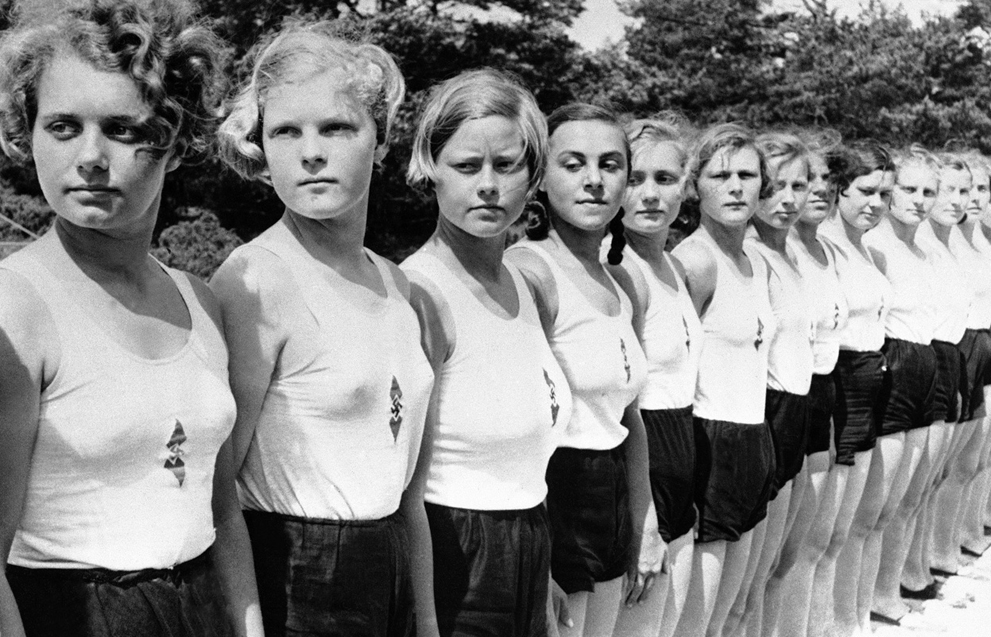
National Socialists tried to subvert German Theosophists to support the Reich
“There’s a general trend toward a post-traditional spiritualism or transcendentalism in France and Britain (and there are many good books that look at those movements in parallel to Germany). The difference I think is that it was more privatized and apolitical. The kind of theosophy popular in America around this time would normally go on in your drawing room, in the woods, or an artist’s community. The [spiritual philosophy of] anthroposophy of occultist Rudolf Steiner, for example—which did find some inroads in Great Britain and America—didn’t become so politicized or racialized as it did in Germany and Austria.”
ERIC KURLANDER
When the post-traditional Theosophical Movement and Society was in descent (keep in mind there was a “Theosophical Society” of Swedenborgians before them), the German populist völkisch movement arose. The nineteenth-century Theosophical Movement declined by the end of the 1930’s, when the National Socialists and Fascists began to rise to prominence and power. The trend of human affairs tended toward war, rather than national sympathies and “universal brotherhood.” The first German publication to utilize the swastika was Lotusblüten (Lotus Blossoms, 1892-1900), which contained H.P.B.’s writings. Theosophists enjoyed some success in Germany but then came the National Socialists.
In Prof. Vincent A. Lapomarda’s work, The Jesuits and the Third Reich (2005 ed), he speaks of Nazi documents, saying of them, that “Himmler modelled his SS so closely on the Jesuits that even Hitler called him ‘my Ignatius Loyola’.” “Himmler kept a medieval castle, the Wevelsburg, which served, so to say, as the SS monastery. (…) Hitler not only regarded the SS as his Jesuit Order but insisted that these Nazis became familiar with The Spiritual Exercises written by St. Ignatius Loyola…”
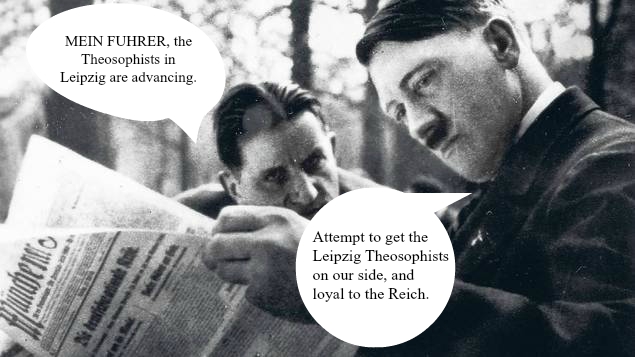
The National Socialists wanted to utilize and subvert the German Theosophists to serve the führer. Hugo Vollrath was head of Theosophical Society in Leipzig, and Heinrich Himmler sought to subvert the German Theosophical Brotherhood. Vollrath admitted pursuance to place German Theosophists in pro-Nazi stance, stating contribution to integrating or co-opting Theosophical concepts, and its movement in Germany into the Nazi state. Hermann Rudolph and Hugo Vollrath, who competed for the Leipzig Theosophists presented their own theosophy to the National Socialists as the vehicle for German renewal.
In time, Austrians and Germans formed pseudo-occult and pseudo-theosophical groups through Guido von List, Jorg Lanz von Liebenfels, and Julius Streicher. Heinrich Himmler ordered the Gestapo on a mission to subvert German theosophists, and kept orders under surveillance, because Fascism and National Socialism requires absolute obedience.
The rise of National Socialism came with new fascination in ancient religions and “occult arts” (e.g., parapsychology beliefs). Whenever bringing up the subject of “Nazis and the Occult,” the common tendency is toward condescending and ominous tones of the term “occultism.” Eric Kurlander, author of the new Hitler’s Monsters argues that many Germans and some National Socialist circles believed in the supernatural and parapsychology, like astrology, telepathy, etc. The National Socialists resorted to “border science” and esotericism, he states in a recent interview.
Vice’s J.W. McCormack asks Eric Kurlander in Hitler Used Werewolves, Vampires, and Astrology to Brainwash Germany:
“Do you have a sense of why these occult practices flourished in Germany in particular?”
Eric Kurlander replies:
“There’s a general trend toward a post-traditional spiritualism or transcendentalism in France and Britain (and there are many good books that look at those movements in parallel to Germany). The difference I think is that it was more privatized and apolitical. The kind of theosophy popular in America around this time would normally go on in your drawing room, in the woods, or an artist’s community. The [spiritual philosophy of] anthroposophy of occultist Rudolf Steiner, for example—which did find some inroads in Great Britain and America—didn’t become so politicized or racialized as it did in Germany and Austria.”
“The fascinating thing in the Central European supernatural imaginary is that all that worldwide interest in things like Atlantis or the search for the Holy Grail get racialized and hierarchized into ideas like the existence of the lost continent of Ultima Thule, or Hyperborea, which plays into grand historical narratives of Aryan racial purity. Norse traditions like frost giants found their way into World Ice Theory, which Hitler and Himmler wanted to adopt as the official cosmology of Germany, and some contemporaries suggest led to Hitler not properly equipping his soldiers on the eastern front, since Nordic peoples were ostensibly more immune to cold.”
As Eric Kurlander atleast recognizes, the völkisch movement intertwines with National Socialism, but are different historical phenomena. Folkdom comes out of Romanticism, where mythology and folklore is integral to its movement’s expression and interest as in post-traditional theosophy. Eric Kurlander is aware of the influence of traditional German myth on the National Socialists. The volkstum conception and völkisch movement combined with the populist (volkstümlich) idealism of the National Socialist Party contributed to the creation of this new political religion.
However, Joseph Goebbels spoke against being labeled “pagan.” When the Germanic peoples adopted Christianity, it still retained the impression from their folk tradition and lore. Joseph Goebbels believed that the Germans were lucky for a Christianity that was not in opposition to it.
 The Minervan Republic