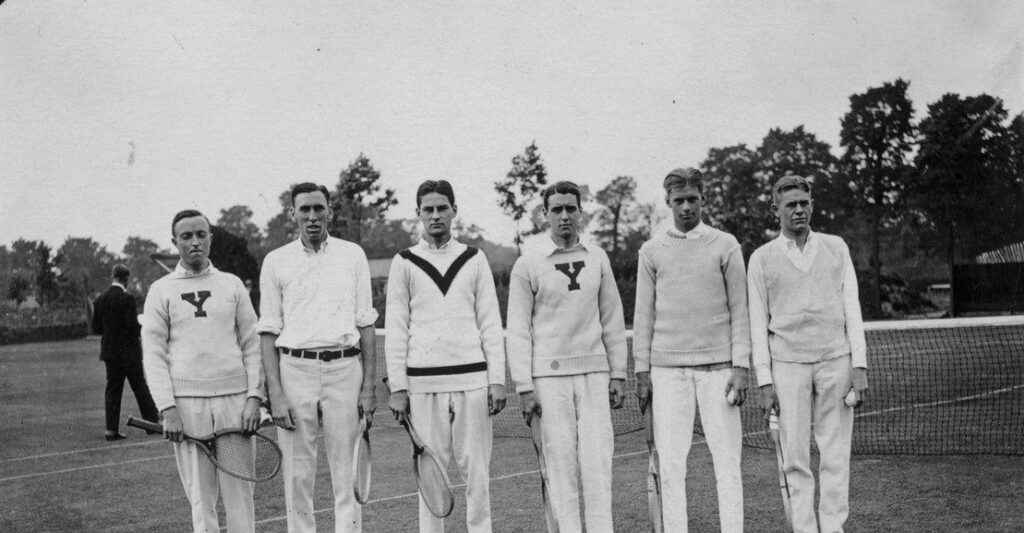
WASPS WERE THE LAST GROUP THAT SAW THEMSELVES AS THE CUSTODIANS of this civic order, and though they were not always inclusionary or fair, this was the civic ethos. It was part of the civic eco-system. When these institutions declined, the civic world collapsed; not because they, nor the WASPs were special, but because no one replaced the custodial role.
Tim Dillon and the hosts of History Hyenas exhibit the attitude towards such clubs in general in this clip.
The WASPs were not the lone group that upheld America’s civic tradition, and America is not fundamentally a “Germanic Protestant culture.” The story of American civic identity is truly plural and contested. From the colonial era through the early republic, civic republican ideals of self‑government, civic virtue, and resistance to arbitrary power were articulated and defended by a wide range of actors: English dissenters and Anglicans, Scots‑Irish Presbyterians, Dutch and German settlers, Catholics, Jews, Quakers, Black and Indigenous political actors, and immigrant communities. These groups drew on different intellectual lineages: classical republicanism, Enlightenment liberalism, religious dissent, and local customary practices, and adapted republican language to local grievances and political projects. To reduce the American experiment to a single ethnic or confessional origin flattens that complexity and obscures how competing visions of citizenship were negotiated in courts, legislatures, town meetings, and social movements.
All these factors and groups shaped republican language and institutions, because REPUBLICANISM in early America was a plural civic tradition.
Republican ideals and liberalism in the Revolutionary and early‑national eras were contested, shared, and repurposed across communities rather than monopolized by an Anglo‑Protestant elite. Historians like Gordon S. Wood and Joyce Appleby show that the Founders debated a mixed inheritance of classical republicanism and Enlightenment liberalism rather than drawing from a single cultural font, and that this debate produced institutions (state constitutions, conventions, and the federal Constitution) designed to manage factional pluralism.
We must be very careful not to allow erasure of this important history. Republicanism was a shared, negotiated civic practice, mobilized by diverse groups, rather than an ethnic or confessional monopoly. Radical state constitutions (e.g., Pennsylvania’s 1776 constitution with its explicit republican language and broad franchise experiments), which reveal how local political cultures of urban artisans, frontier settlers, and immigrant communities, translated republican rhetoric into law. Catholic and Jewish actors participated visibly in public life: Charles Carroll of Carrollton, the only Catholic signer of the Declaration, served in state and national office and left extensive papers documenting Catholic engagement in republican politics.
Likewise, Jewish financiers and civic actors such as Haym Salomon provided crucial fiscal support to the Revolution (Haym Salomon, the Financier of the Revolution) and appear in contemporary ledgers and correspondence, demonstrating material as well as rhetorical contributions from non‑Protestant communities. Black petitioners and free Black activists used republican language to demand rights and legal redress. The Massachusetts “freedom petitions” of the 1770s are primary documents showing how enslaved and free Black men invoked the Revolution’s language of liberty to press for emancipation. The Scots‑Irish and Ulster‑Scots also supplied a disproportionate share of frontier leadership, militia officers, and republican pamphleteering; their Presbyterian and dissenting traditions helped diffuse republican ideas beyond coastal Anglican elites (see Scotland and the American Revolution). Finally, the Federalist‑Anti‑Federalist debates (e.g., Madison’s Federalist No. 10) explicitly treat factional diversity as intrinsic to the republic and design institutions to mediate competing interests rather than to enshrine a single cultural identity.
WASPs were eventually replaced by the technocrats, and technocrats do not join such clubs; and White‑identity movements emerged as a reaction to the perceived collapse of a civic custodial class (WASPs), the reframing of elite institutions as exclusionary, and the rise of a new, mobile technocratic elite that neither performs local civic stewardship nor accepts traditional status‑based obligations.
Once the WASP elite collapsed, so did that civic world. The history of civic institutions was reframed by identity politics as merely “white clubs,” patriarchal and outdated. However, they were being replaced by a new elite detached from local life, global, data-driven, just as arrogant, and mobile; and do not see themselves as “custodians of the republic,” but as experts demanding data-driven “efficiency.”
- As older local elites dispersed through economic change, suburbanization, and meritocratic openings, the dense networks discussed in The Stages of the Collapse of American Republicanism, Civic Associations and Community that once mediated civic life weakened. That erosion left a vacuum of visible, place‑based stewardship that many experienced as a loss of social order.
- Progressive critiques did expose real patterns of exclusion in clubs and institutions; those critiques also simplified complex civic roles into moral labels (“white,” “patriarchal”), which made it easier for aggrieved groups to mobilize identity‑based narratives.
- New elites in managers, consultants, and credentialed professionals tend to prioritize systems, metrics, and mobility over local rituals and long‑term custodial obligations. Their legitimacy rests on expertise rather than inherited civic stewardship, so they rarely perform the symbolic, ceremonial, and social functions that older elites did.
Progressives see the old custodial world as exclusionary; and conservatives see its dismantling as cultural dispossession. Both readings contain partial truths. In the continuity of elitism in a new form, technocrats can be as socially distant and self‑assured as the old elites. The difference is how they justify or claim to justify authority, which is through “expertise” rather than lineage. The generations today both conservative and progressive do not seem capable of rebuilding the eco-system with the latter having spent the time providing deconstructive, moral critiques of exclusionary and unjust systems, still the American lacks a reconstructive theory. So, recent generations have excelled at critique, at exposing exclusion, corruption, and injustice, but have not coalesced around a widely accepted, practical theory for rebuilding civic institutions. The old custodial roles dissolved, identity and grievance politics filled some of the space, and technocratic elites replaced place‑based stewards without restoring local civic life.
 The Minervan Republic