APPROACH TO STUDY OF THE HISTORY OF RELIGION IN THE UNITED STATES
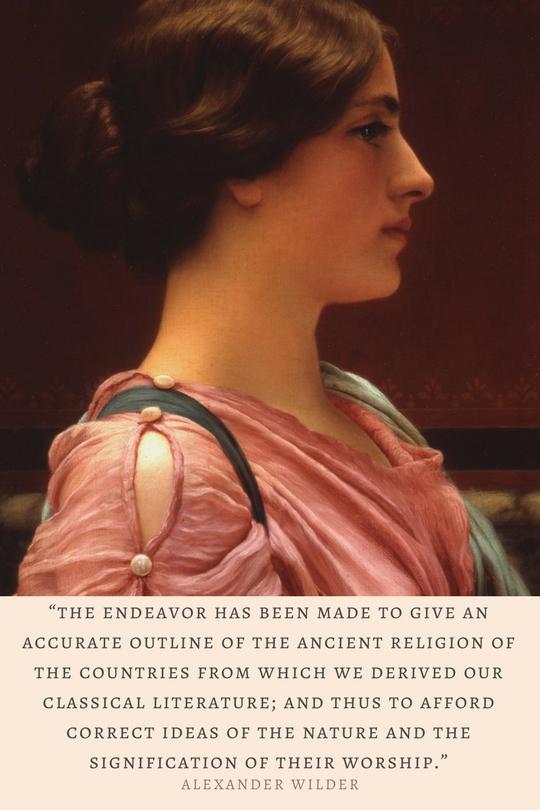
The articles approach to the study and advance of Religion and Theology in relation to Civics in the U.S. is expressed by the nineteenth-century American esotericist, Alexander Wilder.
What is Covered
CIVIC REPUBLICAN VIRTUE: Many early American thinkers argued that republican self-government requires a virtuous citizenry, and they believed religion supported that virtue.
FOUNDING-ERA POLITICAL THEOLOGY: Sermons, covenant theology, and Protestant political thought influenced ideas about liberty, authority, and rights.
CHURCH-STATE DEBATES/SECULARISM: The First Amendment, disestablishment, and religious liberty are central to the American republican tradition.
RELIGIOUS MOVEMENTS AND REFORM: Abolitionism, temperance, civil rights, and other movements often blended religious and republican arguments.
PLURALISM: American republican tradition was not shaped by a single doctrinal worldview but by a mix of spiritual, philosophical, pagan revivalist and fraternal currents from dissenting Protestant sects to eclectic Freemasonry that prized civic virtue over dogmatic uniformity. This history is widely distorted, understudied, omitted or ignored because the fact is hated. It’s precisely this intellectual and spiritual diversity that allowed the founding era to resist literalism and authoritarianism, making space for a civic order grounded in reason, conscience, and voluntary association rather than enforced orthodoxy. It has declined, and the expressions dominated by literalism and authoritarianism have gained ground. Atheism is not sufficient to challenge this force.
WHY FOCUS ON THE UNITED STATES
Being American, the affairs, potential and conditions of my own country as a citizen, and the Americas in general is of vital interest to me. I am motivated by the fact, that in our day, many sides, groups and political ideologies, including those taking advantage of religious conflicts and racial animosities have gained influence.
MOVING AMERICAN CULTURE
We seek to cast away materialistic excesses and distractions, to mold ourselves through spiritual exercise and action into the civic voices, theologians, protectors, exemplars, scholars, literary writers and philosophers of our era and beyond. The idea is to not give rise to the creation of new religious innovations, but to provide strength.
The creation of republican-minded, or civically informed citizens is a struggle of necessity and for the Truth, and a plea for Wisdom in governance based on a knowledge of its foundations. We are capable of producing a devastating counter to the various forces of Christian Nationalism and should be ready to do so.
***
THE BIRTH OF A CONSPIRACY IN AMERICA
The idea of The American Minervan was initially born from an explanation period into the history of America and origins of American political tradition, as a critical reaction against Manly P. Hall’s “The Secret Destiny of America,” that mirrors the views of William Q. Judge. Both Hall and Judge argued that America was not an accident of history, but the deliberate result of a “Great Plan” carried forward by hidden enlightened philosophers. Judge and Hall maintained that the American Revolution and the drafting of the U.S. Constitution was overshadowed and influenced by “adepts.” Utilizing the correspondences between Theosophists Helena P. Blavatsky, William Q. Judge and Chhabigram Dolatram in the nineteenth-century on whether clandestine individuals (historically known as adepts or “secret chiefs” in Masonry) were involved in the American Revolution, it is shown that Blavatsky rejected this enthusiastic belief of Judge. She replied to Dolatram, that the Revolution partly owes itself to independent liberating efforts of Freemasons, Rosicrucians and Enlightenment radicals acting from their own ideals and philosophical commitments, not as a command, or divine decree from a singular body as a directed political destiny.
The aims of the German Rosicrucians and the historical Bavarian Illuminati, in addition to Thomas Jefferson’s brief thoughts about them and the French Revolution also led to the early articles and essays.
The symbolic-mythic and providentialist framing of the Founding can lead to romanticism, but points to preceding influences from Europe and converging interests, leading to the complex birth of the U.S. secular republic, and not a monarchy, or theocracy.
The political history side of the research also began with the World War I and II era towards the defeat of Fascism, and investigating the political mythos of the Third Reich (Drittes Reich). The intent in studying Fascism is mainly to a) compare with American Republicanism — both being or claiming the Heritage and Legacy of Rome; and b) resolve and neutralize outdated and conflicting conspiracy that relate Gnosticism, Occultism or Theosophy to antinomianism, Communism and Socialism, Fascism or National Socialism. This investigation immersed me into a detailed study of the roots of the American Revolution and the philosophico-political influences underlying the foundations of U.S. government and back up through the entire history of Italian Unification (Risorgimento) into the philosophy and origins of Italian Fascism. There are key religious, cultural and philosophical dimensions and currents, that emerge within the research that need to be carefully explained.
SOCIOLOGICAL PARANOIA OF CONSPIRACY IN U.S. POLITICAL THINKING
The study and history of conspiracy theory (e.g., the New World Order conspiracy theory) is interwoven into the history and mass psychology of America, such as the anti-Masonic attitude that developed in the early history of the U.S. Stemming from this is the Illuminati conspiracy, which began at its basis as a convergence of Protestant and Catholic attitudes towards Jews combined with the anti-revolutionary retort of conservative-monarchist forces, against republican revolutionary culture and the radical groups that emerged out of this culture, that were being built up during and after the time of Johann Adam Weishaupt and his Bavarian Order of the Illuminati in the eighteenth-century.
The real history and ideas complement our history, rather than conflicts with it, and those that are not knowledgeable of it cannot truly claim the essence and legacy of the political system, nor would they be able to defend it against their own moral failings, corporate and donor interests, despotism and theocratic visions.
THE HIDDEN WEST
With reverting Protestant intolerances, irrelevance of shallow political mottos, deceitful platitudes of the Politician, and the advent of neo-traditionalists and sympathetic White ethno-nationalists, I want to show how an expansion or incorporation of complementary elements to the foundational political system in Republicanism can enhance American Identity, Knowledge and Culture in our day. Those that will represent this vision must help to divert the force of the people, rather than contribute to the racial obsessions and “culture wars” that define our age. Radically departing from these attitudes, we want to challenge a people who terribly labor under limited views about its Identity that try to center it in either a post-War superficial multiculturalism, Christian pluralism, Southern tradition or the “Lost Cause” Confederate tradition, or the heritage of the legacy “White Anglo-Saxon Protestant.”
The articles on Religion in the United States involves studying the history of “The Hidden West.” In most recent periods, this goes through the Medieval Alchemists, Renaissance Platonists, Freemasons, German Rosicrucians, Templars and more (see Crusades to Late Renaissance Occultism to Enlightenment Timeline (1075-1680).
Therefore, I write about Religion partly to dissect and challenge the ill-informed and malicious tactics of Christian and monotheist religion polemics and propaganda in their exclusivist claims to truth over the “pagan world.” These claims and approaches have led to ever-gradual degeneration of religious thought and bloodshed since their clever constructions. Dismantling core notions and positions within the subject of Christian ecclesiasticism and heresiology — the religion, that has been the dominating influence in the U.S. and in Western Civilization for two millennia is actually key to the advancement in our understanding of Religion, and the repute of Religion, Theology and Esotericism. As long as this is ignored, there will be no true progress.
We are explicitly against the corrupting and degenerating effect of simplification, which also contributes to treating the People like infants out of distrust in their capabilities, or belief in what the People lack. This is not opposite of the democratic spirit. Readers are encouraged to be eager to learn.
 The Minervan Republic