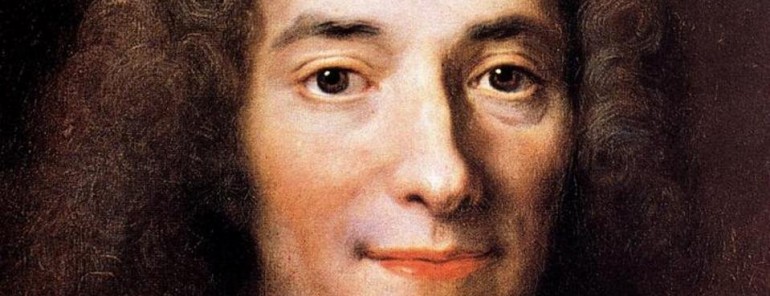
“The first philosophers, whether Chaldean or Egyptians, said: There must be something within us which produces our thoughts; that something must be very subtile; it is a breath; it is fire; it is ether; it is a quintessence; it is a slender likeness; it is an antelechia; it is a number; it is harmony (…) “It is atoms, which think in us,” said Epicurus after Democrites. But my friend, how does an atom think?” (see John Morley’s The Works of Voltaire: A Philosophical Dictionary, Vol. XIII., pg. 311).
VOLTAIRE’S RHETORICAL TRUST IN THE PHILOSOPHICAL DICTIONARY and appearing in discussions of the soul or ancient philosophy of mind, is a classic Enlightenment critique of reductive materialism, which was central to some conversations in my Integrating Seminar on Charles Taylor and Secularism. Voltaire first surveys the rich variety of ancient attempts attributed broadly to “Chaldean or Egyptian” thinkers and their Greek heirs to name the subtle internal principle responsible for thought and animation: breath (pneuma), fire, ether, quintessence, a slender likeness (eidōlon-like image or subtle form), entelechy (Aristotelian actualization of potential), number, and harmony. These are not crude matter but refined, often dynamic or participatory realities. In his end question, he explains the gap; that atoms may account for bodies in motion, but they offer no intelligible account of consciousness, intentionality, or qualitative experience. Voltaire argues that the ancient philosophers already recognized the need for something subtler than gross corporeality or random particles. Heraclitus (c. 500 BCE) supplies one of the earliest and most influential “fiery” models. FIRE is not merely an element but the archē, or the ever-living, transformative principle of the cosmos. The soul (psychē) participates directly in this fiery reality and is itself fiery in its highest state. This inherited philosophy is at the root of Human Rights theory. Heraclitus explained that the soul’s depths exceed the body and share in cosmic rationality (in the LOGOS).
The Chaldean Oracles taught that the soul is a “vital spark” or “bright fire” that is immortal, life-giving, and capable of ascent when rekindled by intellect and ritual. Practical theurgic ascent requires extending the soul’s fiery nature since all reality flows from “One Fire.” The thinking principle is thus a subtle, radiant, intellect-infused fire-spark, precisely the kind of “something within us” Voltaire catalogs, placed in the body yet not reducible to it, and able to “think” or know because it participates in the divine NOUS. Voltaire’s position on the breath, fire, ether (or quintessence), number and harmony is a syncretic 18ᵗʰ century encapsulation of these and related ancient intuitions. Both traditions of the Presocratics and Chaldean Oracles answer Voltaire’s atomist challenge by making thought intrinsic to a subtle, dynamic, participatory principle as fiery, rational, and divine, rather than an accidental property of inert particles. They portray the thinking principle as something we can participate in and rekindle. This is a science.
Except, Voltaire does not recognize this science. Voltaire merely invokes the theoretical side of this ancient wisdom, which is atleast the recognition that thought requires something subtler than atoms to mock crude materialism. Yet the full practical science of rekindling the soul through theurgic rites would likely have struck him as enthusiasm or superstition in the face of the Enlightenment skepticism this era of thinkers sought to revise out of the history. It was that that philosophy of rekindling of the soul through symbol, ritual, contemplation, and alignment with the divine fire, that is exactly what made these traditions function as sciences of the occult in antiquity: rigorous, cosmological, and soteriological at once. Voltaire uses the ancient metaphysics against Epicurean atomism, while remaining deeply skeptical of the ancient practices that made that metaphysics operational.
 The Minervan Republic