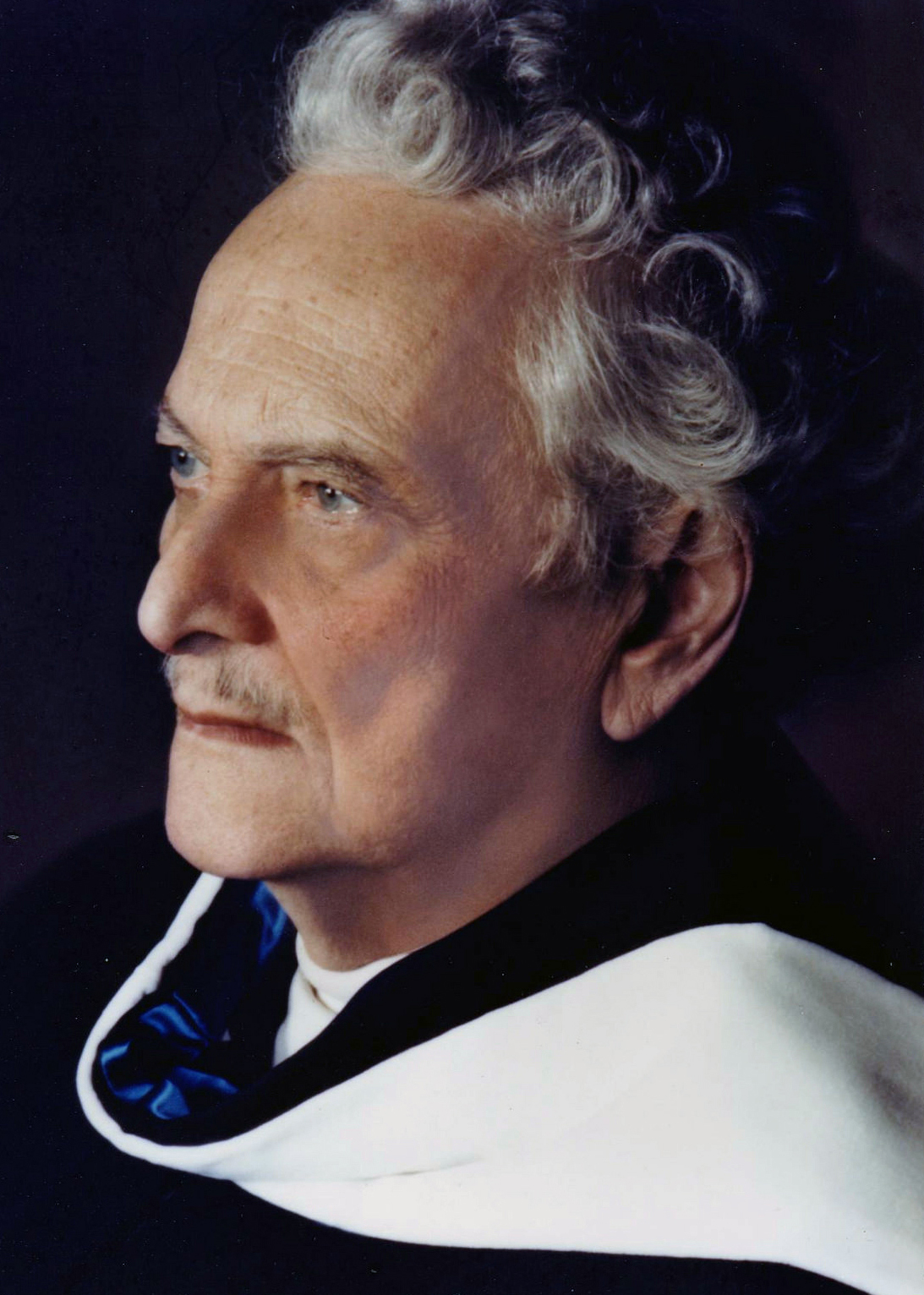
This is from Manly P. Hall’s lecture on H.P. Blavatsky and The Secret Doctrine, the fifth and final talk in his 1962 series Landmarks of Esoteric Literature (delivered May 16, 1962, in Los Angeles). Manly P. Hall was a Canadian-born American esoteric philosopher, lecturer, and prolific author. He is best known for his 1928 encyclopedic work The Secret Teachings of All Ages and for founding the Philosophical Research Society in Los Angeles in 1934. Although he wrote extensively about Freemasonry decades earlier, he was not initiated as a Freemason until 1954 and received the honorary 33° of the Scottish Rite in 1973.
Hall sets the historical and cultural context for why Blavatsky’s work was both necessary and controversial. He is describing the persistent Western (especially Christian) attitude that treated the major Eastern religions such as Buddhism, Brahmanism and Hinduism, Confucianism, and Daoism as “heathen,” heretical, or even diabolical rather than as legitimate spiritual and philosophical traditions worthy of serious study.
“We have not yet reached that point in international thinking, in which we could be fair about the opinions, beliefs, and convictions of other peoples; and even today, if a poll were taken, I think it would be safe to say, that to the majority of Western persons — the Buddhist, Brahmins, Confucianists, Daoists are still regarded as heathens. This situation has improved but not entirely has it been corrected in public thinking. We have really no solid foundation for religious inter-understanding, even at the present time. The Orientalist in the Western world is still regarded with certain suspicion; but a more liberal attitude on the theory of religion has brought with it a measure of tolerance, but not a measure of acceptance. I have recently examined a number of brochures, and pieces of publicity (…) and many of them still contain words, or atleast implications, that all these foreign beliefs are heresies, that they are the works of the Devil, set up to interfere with the development of literal Christian orthodoxy.” (Manly P. Hall, Landmarks of Esoteric Literature)
In his early years Hall was frequently criticized for weak evidential standards in his writings. He was self-taught, began publishing and lecturing in his early twenties, and produced sweeping syntheses (The Secret Teachings of All Ages being the prime example) that freely mixed primary sources, secondary summaries, speculative interpretation, and mythic narrative. Academic and more rigorous esoteric readers often noted that he asserted connections or historical claims without the careful documentation expected even by the standards of his own time. Some contemporaries and later critics accused him of embellishment or of presenting secondary material as settled fact. This does not erase the rest of the record. Hall lectured for roughly seventy years, published more than 150 volumes, and founded an institution that kept comparative esoteric and philosophical material in circulation for decades. His influence on twentieth-century popular interest in symbolism, comparative religion, and the Western mystery traditions is substantial, regardless of the methodological shortcomings of the early work.
There is an animosity towards him, which has several sources. Academic historians of esotericism have tended to treat him as a popularizer rather than a critical scholar. Certain Masonic and occult circles regarded him with suspicion because he wrote authoritatively about their traditions long before he formally belonged to them, and conspiracists take these writings as authoritative. Others simply disliked the grand, encyclopedic style or the public following he attracted. The result has been a polarized reception: strong admiration in some quarters, dismissiveness or hostility in others. Early criticisms of method are worth noting but they do not, by themselves, cancel the scale or cultural reach of the body of work that followed throughout his years. I remain inspired by his work and energy.
Geraldine Beskin gave a lecture on Manly P. Hall titled “The Murdered Mystic,” reflecting heavily on Louis Sahagun’s biography Master of the Mysteries and the longstanding allegations of Hall’s widow, Marie Bauer Hall.
Manly P. Hall died on August 29, 1990, at age 89. Six days earlier he had signed documents transferring substantial control of his personal and Philosophical Research Society assets to his assistant, Daniel Fritz. The circumstances of the death were treated as suspicious by the family physician, who withdrew an initial natural-causes certificate, by Los Angeles police (who investigated and kept the case open for years), and by Hall’s widow, who publicly maintained that he had been murdered — most often alleging suffocation. Reports of the body’s condition (including ants and signs it may have been moved) added to the unease. However, no one was ever charged with, or convicted of, murder. The official determination remained heart-related under suspicious circumstances. In civil court, a judge later ruled that Fritz had exerted undue influence and effectively stolen from Hall; the contested will was invalidated, and Fritz was removed from control of the Society. Fritz himself died of cancer in 2001. The available public record supported a finding of serious financial exploitation and highly irregular circumstances surrounding the death but stopped short of a proven criminal homicide. The case has since remained an unresolved suspicion rather than a settled historical fact.