Steven F. Hayward writes about the classical influences of the American Revolution: “Wood says that the American Revolution was a “republican” revolution. By that he means that it had intellectual roots ranging from ancient Greece and Rome to the English Commonwealth, and that it was more communal than capitalistic. “Ideally,” he writes, “republicanism obliterated the individual.” He explains that:
“…republicanism was essentially anti-capitalistic, a final attempt to come to terms with the emergent individualistic society that threatened to destroy once and for all the communion and benevolence that civilized men had always considered to be the ideal of human behavior.”
STEVEN F. HAYWARD, THE LIBERAL REPUBLICANISM OF GORDON WOOD
The history of republicanism takes us from ancient Rome to even South America’s struggle for independence, involving Simon Bolívar. The first thing is to get us to understand the history of all this. Most of today’s governments of the world describe themselves as republics, or democracies, and the terms are so broad, that we have republican imperialist theories of governing, social democracies, and republics with dictators.
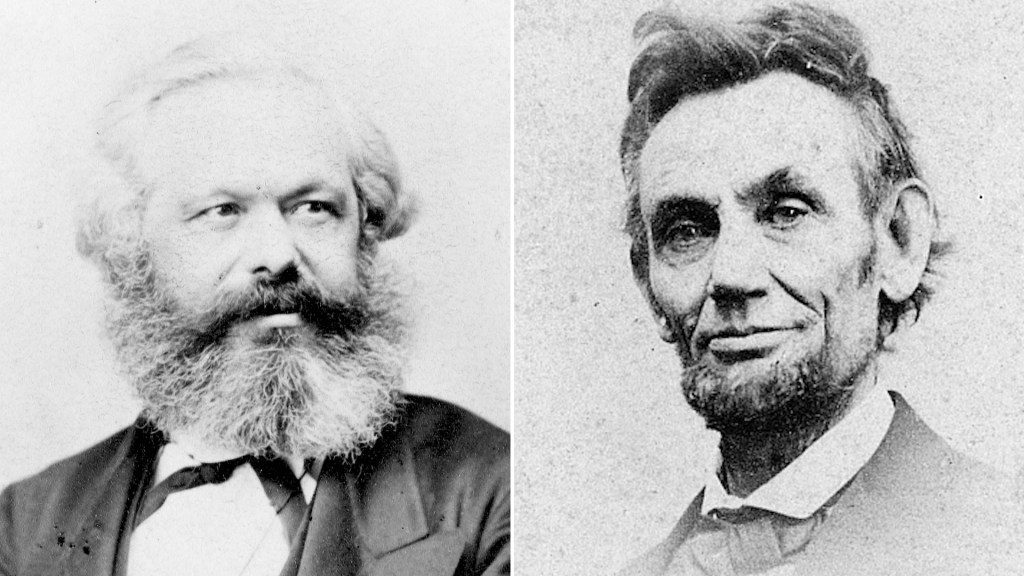
Marx can also be considered within the “republican political tradition” himself, along with Friedrich Engels, Rosa Luxemburg, and James Connolly (The Loose Tradition of Republican Writers), who argued, that a post-capitalist, non-state politic would bring about a social republic, i.e., social republicanism (which corresponds to Marx’s conception).
Abraham Lincoln — regarded as the “father of the Republican Party” — who himself spoke publicly about the European socialists and German Communists was critical of the greed in capitalists, and its coercive machinery.
Unlike many Karl Marx expressed he did not like; he refers to Abraham Lincoln as “the single-minded son of the working class.”
“The workingmen of Europe feel sure that, as the American War of Independence initiated a new era of ascendancy for the middle class, so the American Antislavery War will do for the working classes. They consider it an earnest of the epoch to come that it fell to the lot of Abraham Lincoln, the single-minded son of the working class, to lead his country through the matchless struggle for the rescue of an enchained race and the reconstruction of a social world.”
Karl Marx stated that at the First International Workingmen’s Association to Lincoln in 1864.
The German social democrats and British trade unionists were influential in this time, and Karl Marx (who once seriously considered immigrating to Texas) was a prolific contributor to the New York Daily Tribune, the most influential Republican newspaper of the 1850s.
 The Minervan Republic