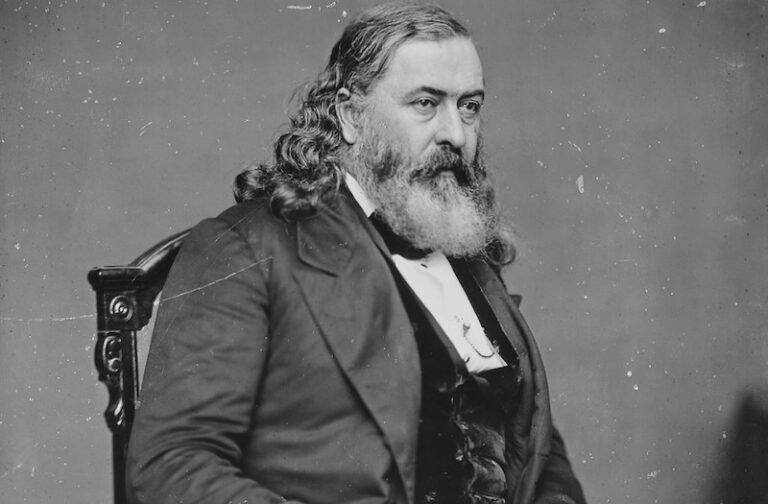
The life and writings of Albert Pike provide a lesson to those interested in the history and study of American Esotericism. This article briefly lays out some facts to consider in light of recent events to challenge both American racial conflicts and limitations and the Trump Administration’s appropriation of Albert Pike (The Unseen Danger of Restoring Confederate Statues and Names). The statue of Pike was recently ordered by President Trump to be restored and reinstalled. Included is a lecture from pastor and author Robert L. (Bob) Uzzel during Black Lives Matter protests (2020) discussing the mixed legacy of Albert Pike.
There is a story to how Scottish-Rite Freemason Albert Pike got his statue (now destroyed) in Washington D.C. (Protesters Topple, Burn Statue of Confederate General Albert Pike in Judiciary Square). His Freemason fellows funded and advocated for his statue, and it was authorized by Congress. Pike’s story was therefore, in this sense, reconciled within the context of the Civil War and the Union. Albert Pike’s life was extraordinary. As I have studied, as Manly P. Hall explains in his lectures, and other few scholars state, like Robert L. Uzzel, Pike could not rise fully above his own limitations, but his writings demonstrate a man trying to break out of those limitations. One adopts this perspective by studying the evolution and content of his writings.
Manly P. Hall examined through a long series of seminars on what Pike was attempting to do in his works, regarding the Wisdom Religion in Iran, e.g., in Indo-Aryan Deities and Worship, although containing errors.
Others have closely examined his writings, which were influenced by Levi and Kabbalism. Concluding opinions of him as merely a traitor is not the best perspective and is not conducive to the larger picture. Analyzing Pike, his work and his faults within historical context teaches us all a lesson and is important against modern racialist adaptations of Nordicism and racism.
The outlining of Republicanism by Albert Pike is not related to the “Lost Cause of the Confederacy” theory, but it is true that the heritage of Republicanism is lost to the Americans. The Republicanism of the founders is a “Neo-Republicanism” drawing upon a mix of historical sources. Other people, like Mazzini spoke and wrote tirelessly about the ideals of the Revolution, while also speaking of the odd predicament the American West found itself in. Leslie Alexander’s lecture is highly relevant to this in Slavery and the Limits of Democracy in the Early Republic.
The opinions about Albert Pike always pivots to a simplified point-of-view, despite being a controversial and complex character during his time. Reading Morals and Dogma would destroy any such simplistic notion and is similar in the case of any degree of defense of Helena Blavatsky who fought unapologetically against racism and prejudice. It reveals the lack of reading. When it was reported that President Donald Trump is considering restoration of Albert Pike’s statue in D.C., many returned to the same viewpoints that were being hurled during the time his statue was destroyed. Contrary to these views, Pike explains the entire revolutionary republican philosophy in his magnum opus, and the meaning of its three-word motto modeled by the French. In Morals and Dogma, you will find not a single racist statement. Pike is strictly addressing his fellows, urging them to take care of and be protectors of all the people, and preaches the motto of the Revolution. He did not die a rabid racist or propagandist, like so many others of our present day, who have no excuse for their racism.
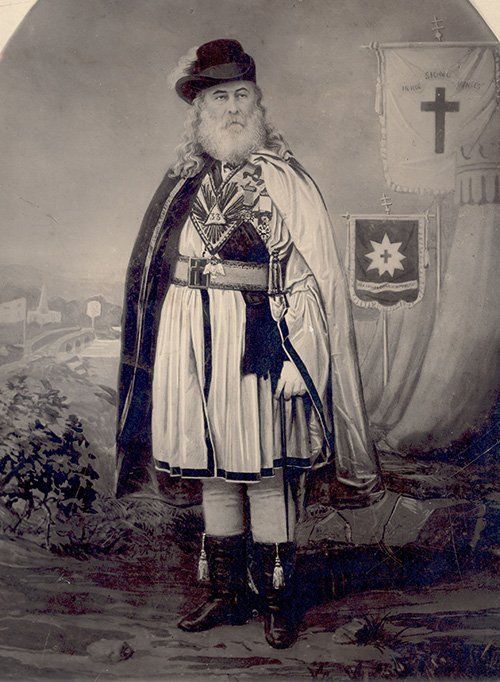
Pike was celebrated not merely for his work. He was not given a statue, for the Confederacy, or any beliefs about the contamination of Whites by the Negro. What he was fighting for, he explains in his own words in his major work. Any White American, if they were honest in reading him would have to choose the path of the philalethean (seeker of truth) and see those writings as an instructive means to develop beyond the conditioned racism, which so consumed many of that time and still in ours.
The work of the Freemason, Pike taught, was to help mankind and work towards its amelioration, pleading to turn to the “light of knowledge.” He explained that this “light of knowledge” is God, the Bible, the liberal arts and arcane knowledge. He directly and explicitly rejected the pride and egotism, that was associated with the mythical character of Lucifer. The reader is therefore often taken aback by this discrepancy in relation to the perspective that he was just some White racist traitor Confederate.
One of the issues with dealing with a controversial and maligned character mixed with false conspiracies within the history of esotericists and philosophers, is that these characters are complex. His library of writings is not tinged or stringed along with racist statements and are instructive to any philosophical aspirant, but we can learn from his history of shortcomings, as no man is flawless. Pike seems at his most pathetic moments in life and after being forced to submit to the Union, trying to undergo some years in solitude development of his thinking, though he could not fully move past his limitations. After the Reconstruction era, he only very late into his years began to moderate and reform his white supremacist views. Viewing Albert Pike in this sense into his post-war life in the reunited United States, provides clues to the contradictions of his character and legend. The persistence in perpetuating lies about his passage on Lucifer is a sad example, and unfortunately, we have to take some means to explain Pike in context, as Pike is one of the figures used to generally attack Kabbalism, Theosophy and Esoteric Philosophy.
At any rate, Pike taught the errors of the white supremacist, of which not all who had in their minds the conception of the Revolution adopted — case in point, Mazzini. The Italian political prophet Giuseppe Mazzini and American Albert Pike share an outlook about the ideal of the Republican Revolution, despite the particular differences in their outlook based on the context of the society they were born. Whereas Pike’s world is shaped by the contexts leading to the War between the Union and the Confederate States of America, relations with the Indigenous, and days of American slavery, the world and perspective of Mazzini is different. Mazzini, who inspired a slave rebellion in the States, was anxious for the American Republic to get rid of slavery, which he considered evil. Mazzini expressly saw the American Republic as backwards for adopting the ideal of the republican revolution yet choosing to continue the enterprise of the transatlantic slave system. The ideals of the Revolution speak to the heart of the condition of the exploited races, and the beliefs that alone “the White race” ought to govern this country are easily refuted.
The attempt at appropriating Pike’s legacy by Pete Hegseth and the rest of the Trump administration is nothing more than a continuation of the subversion of our efforts to educate and move Americans more into the direction of their true potential as a People.
Robert L. Uzzel, a scholar who did his dissertation on Levi and the Jewish mysteries, explains the mixed legacy of Pike, Pike’s relations with Native Americans, and how Pike largely used passages verbatim from Eliphas Levi’s writings. I highly recommend Manly P. Hall’s lectures also about what Pike was trying to do in his writings, which are explained in context, and serves as both a lesson and inspiration to students of Studies in Esotericism.
 The Minervan Republic