INTRODUCTION
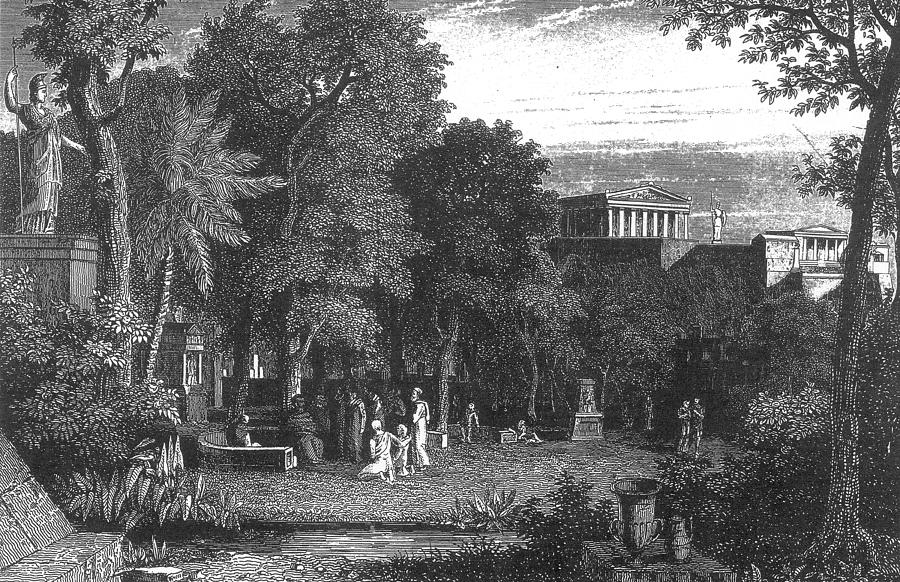
Epicurus (d. 270 BCE), born 341 BC in the Athenian cleruchy (military colony) on Samos was known as the “Garden philosopher,” and Thomas Jefferson’s thinking was inspired by him1. Epicurus was a rigorous Hellenistic atomist materialist whose theology is naturalistic and therapeutic, aimed at removing fear to enable tranquility (ataraxia). His school, Epicureanism was one of the major dominant schools competing for followers across the Greek world during the Hellenistic philosophical era, or the period after Aristotle (323-31 BCE). In his Letter to Menoeceus (also called the Letter to Menoikeus), his naturalistic theology expresses the belief that multiple gods exist, but they are not what popular opinion (“the many,” cultic, mythic, or state religion) supposes. The truly impious (asebēs) person is not the one who simply denies the gods of the crowd, but the one who attributes to the gods the crowd’s false beliefs, especially those implying intervention, anger, reward, punishment, bureaucratic cosmic governance, or beyond human categories. This removes the fear that superstition gives rise to.
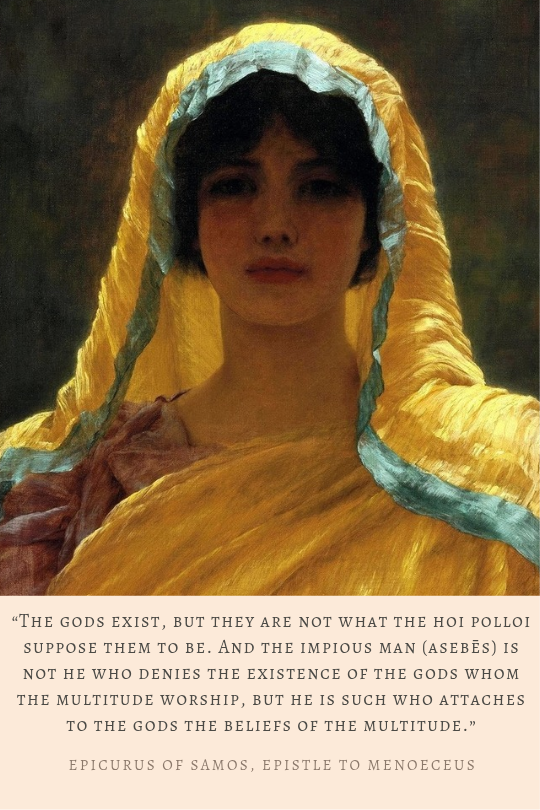
“The gods exist, but they are not what the hoi polloi suppose them to be. And the impious man (Gr. ἀσεβὴς, asebēs) is not he who denies the existence of the gods whom the multitude worship, but he is such who attaches to the gods the beliefs of the multitude.”
EPICURUS OF SAMOS, EPISTLE TO MENOECEUS)
EPICURUS’S NEGATIVE THEOLOGY
The existence and nature of the gods, as opposed to “what the many suppose them to be,” is important in understanding Epicurus’s theology and his “naturalistic explanations.” Epicurus leads us to question then, “what are the gods,” as opposed to not only what the multitudes believe and worship, but as opposed to what monotheistic religions have taught the gods are when attacking the old philosophers as the “idol-worship” of the multitudes (or of the state, cult or empire).
The approach Epicurus engages in is to describe the gods by what they are not, in which he preserves the word “gods” and a basic preconception while stripping away the anthropomorphic, providential, fear-inducing attributes that dominate popular religion. Epicurus’s system is atomistic materialism, that argues reality consists only of atoms (indivisible particles with size, shape, and weight) moving in the void. Atoms (and void) are the ultimate building blocks of everything. Gods are highly specific, stable compounds of fine atoms in the intermundia (metakosmia), not the primordial elements themselves, nor are individual atoms divine. Everything, including souls, minds, and gods are temporary or stable aggregates of atoms. There is no immaterial realm, no transcendent Forms, no divine creation or governance. The notion that the atoms are gods, or the gods are primordial elements would introduce a hylozoic or pantheistic interpretation (closer to some Stoic or later Neoplatonic ideas) foreign to Epicurus’s school. Epicurus is strictly mechanistic.
The gods are living, immortal, and supremely blessed (makarioi) in perfect ataraxia. In a qualified sense, their atomic structure is eternally replenished and stable. They dwell in the intermundia (metakosmia) or spaces between the innumerable worlds (kosmoi) completely isolated from our world and unaware of human affairs. In later Epicurean sources (e.g., Philodemus), their “bodies” are described as being composed of the finest atoms, as “quasi-bodies” with “quasi-blood.” They emit thin films of atoms (eidola or simulacra) that can reach human minds, especially in dreams or through direct mental apprehension (epibolē phantastikē tēs dianoias), producing the universal prolepsis (preconception or anticipatory notion) of immortal blessed beings.
PHYSICS LIBERATES ETHICS
Central to Epicurus’s philosophy is that all phenomena (thunder, earthquakes, celestial events, even dreams) receive atomic and mechanistic accounts. Multiple explanations are often acceptable if they fit the phenomena and do not introduce superstition or fear, but the Gods are never causal agents in the world. This is the heart of his “naturalistic” program: physics liberates ethics.
An explanation of features in the naturalist philosophy of Epicureanism:
- Ritual Conditions: Epicurus rejects magic, divination, prophecy, and any efficacious ritual contact with gods. Gods do not respond or “work” with humans.
- Theophany: Passive simulacra may reach us; but gods do not actively appear or manifest in theurgic or a visionary ritual sense.
- Theopathy or Theopneusty: divine passion, assimilation is not taught by Epicurus. Gods are indifferent; and there is no “assimilation,” inspiration, or substance-combination with the divine.
- Communing with Gods: There is variation in proximity or substance to the gods, but there is no communing with gods. Gods are unaware of us. Any mental contact is one-way and uniform through fine atomic films or rational contemplation of the ideal. No degrees of closeness or blending of natures is expressed in Epicurean teaching.
- Lucidity: emancipation (from fear) and clarity do arise in Epicureanism, but from understanding atomic physics and the true (indifferent, blissful) nature of the gods; not from mystical communion or divine states.
Epicurus’s idea of “emancipation” is thoroughly this-worldly and rational. He advocates to banish fear of gods, death and pain through natural explanations and modest living. “Living as a god among men” is ethical mimesis of the ideal, achieved by philosophy, not through theurgy or divine influx. Epicurus affirms the existences of plural gods while rejecting their popular characterizations. However, his letter criticizes any theology that attributes false, fear-inducing qualities (providence, anger, cosmic involvement) to gods, whether popular polytheistic myths, civic cults, or later providential monotheism. He is not waging a war against exoteric religion or empire in favor of a mystical wisdom, because his critiques are philosophical and therapeutic. His view is that false beliefs about gods cause unnecessary suffering, and emancipation and lucidity come from a combination of physics and ethics, not from assimilation of divine elements, divine operations or practices.
- Jefferson wrote in 1819, “I too am an Epicurean. I consider the genuine doctrines of Epicurus as containing everything rational in moral philosophy which Greece and Rome have left us.” (Extract from Thomas Jefferson to William Short, 1819) ↩︎
 The Minervan Republic