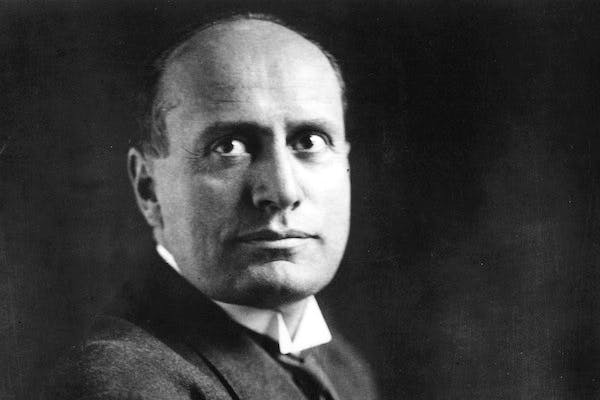
A few months ago, I ordered from Amazon the film Il Giovane Mussolini (1993), renamed “Benito: The Rise and Fall of Mussolini.” I wanted to see what difference the film was to the later more psychological interpretation of Mussolini’s mind in Vincere (2010). In The Young Mussolini, Benito Mussolini is played by now famous actor, Antonio Banderas. Susanne Lothar co-stars beside him as Angelica Balabanoff a close associate who would go on to help establish the Italian Democratic Socialist Party, though the film depicts her as a founder. Benito Mussolini is quite a very intriguing figure in history to me, more than Adolf Hitler, and I had neglected to learn more about his life and influences. Mussolini believed that he was a re-embodiment of Giuseppe Mazzini in political spirit. I’ve become fascinated with alternative scenarios, considering what made Mussolini and the decisions he made; and seeing that he had such an opportunity not afforded to other men in history, to bring to the unifying “New Italy” after the Franco-Prussian War in 1870 (involving Giuseppe Garibaldi and Victor Emmanuel II) the pride many people of the new nation had lost and longed for once again. Benito Mussolini promised them the glory of a New Roman Empire, which he defended in an interview:
“I was accused of tyranny, which I imposed on the Italians. How they will mourn it. And it will have to return, if the Italians want to be a nation again and not a bunch of slaves. And the Italians will want it. They yearn for it. The furious people will chase away the false leaders, the base little men who have submitted to foreign interests. They will bring flowers to the graves of the martyrs. To the graves of the fallen for an idea that will be the light and hope of the world. They will say then, without flattery, without falsehood: Mussolini was right.” (Benito Mussolini, Palazzo Monoforte, Milan Interview)
Angelica Balabanoff (1878-1965) was a Ukrainian-born Jewish revolutionary who became one of the most influential figures in early 20ᵗʰ century Italian and international socialism, and met the destitute young Benito Mussolini in Switzerland around 1904. She was already a seasoned activist. After rejecting her family’s wealth, studying philosophy and literature in Brussels, and attending Antonio Labriola’s lectures in Rome, she had joined the Italian Socialist Party (PSI) in 1900. Assigned by the party to organize Italian immigrant workers in Switzerland (Lausanne, Lugano, St. Gallen), she founded the women’s socialist paper Su, compagne! and served on the Swiss section’s executive committee, representing Italian socialists at Second International congresses.
Italian democratic socialism and republicanism have long been intertwined, though never identical. From the late nineteenth century, the reformist current of the PSI (Turati, Kuliscioff, later Bissolati) and many maximalists shared an anti-monarchical culture inherited from Mazzini and Garibaldi: the monarchy was seen as a barrier to both national unification completed in a popular key and to the social emancipation of workers. After 1946 the overwhelming majority of democratic socialists, first in the PSIUP and then decisively in Giuseppe Saragat’s PSLI/PSDI, embraced the Republic as the necessary institutional framework for parliamentary socialism, anti-communism, and Atlantic alignment. Angelica Balabanoff’s own post-war adherence to the PSDI placed her squarely in this republican-democratic socialist lineage. Republicanism for them was less a Jacobin cult of the people than a pragmatic defense of constitutional liberties against both residual monarchism and totalitarian temptations (Fascist or Communist). The connection between Italian democratic socialism and its republican tradition was instrumental, because democracy and the Republic were valued primarily as the political space in which a non-revolutionary, reformist socialism could operate, in explicit contrast to the maximalist dream of immediate proletarian revolution that the young Mussolini had once shared and later repudiated.
Mussolini, born in 1883 in Predappio (Romagna) to a blacksmith father who was a local socialist and First International member and a devout Catholic schoolteacher mother, had fled Italy in 1902 to avoid military service. Living in extreme poverty, drifting between manual labor, occasional teaching, and socialist-anarchist circles, he struck Balabanoff as a “wretched human being” more absorbed in inner turmoil than in doctrine. She helped him find work, introduced him to Marxist texts, and collaborated with him on translating Karl Kautsky’s Am Tage nach der sozialen Revolution. Mussolini himself later acknowledged that without her he might have remained “a Sunday revolutionary.” Their relationship was intellectual, political, and possibly intimate, but lasted roughly a decade; and placed him firmly inside the revolutionary (maximalist) wing of Italian socialism rather than its reformist current led by Filippo Turati and Anna Kuliscioff.
The 1993 film “Benito: The Rise and Fall of Mussolini” (or The Young Mussolini), basically traces his path from provincial schoolteacher and agitator through Swiss exile, editorship of local socialist papers such as Lotta di Classe in Forlì, and his dramatic rise inside the PSI.
In the film, the scenes of Mussolini with Angelica Balabanoff are revealing. From their very first interactions, and throughout the film, where we find the young revolutionary socialist Mussolini constantly in trouble. He is exiled by the Austrian empire, and Balabanoff again hopes that Mussolini would change his ways. Balabanoff is shown repeatedly urging him to “study, study, study” to master the theoretical foundations of class struggle rather than rely on street-preacher passion. This was her efforts to deepen his Marxism beyond the eclectic mix of Bakuninist anarchism, revolutionary syndicalism (Arturo Labriola), and later Nietzschean and Pareto influences that already colored his thinking.
At the 1912 PSI Congress in Reggio Emilia the maximalists, with Mussolini as a leading voice and Balabanoff’s support, expelled the reformist deputies (Leonida Bissolati and others) who had backed the Libyan war. Mussolini became director of the party daily Avanti!; Balabanoff was appointed deputy editor. Their collaboration was intense but short-lived. By mid-1913 personal and political frictions had already surfaced. When war broke out in 1914, she represented the PSI at the Brussels meeting of the International Socialist Bureau and remained a resolute anti-interventionist and participant in the Zimmerwald movement. Mussolini, after initially signing the party’s neutralist manifesto, abruptly reversed course in October 1914, arguing that Italian participation could accelerate proletarian revolution. He was expelled from the PSI, founded Il Popolo d’Italia, and began the trajectory that would lead to the Fasci di Combattimento in 1919 and the National Fascist Party. Balabanoff never forgave the “traitor”; and her later book Il traditore: Benito Mussolini e la conquista del potere remains one of the sharpest contemporary socialist indictments.
After the Bolshevik Revolution, Balabanoff went to Russia and briefly served as secretary of the Comintern, then broke with Lenin over the regime’s authoritarianism and the suppression of dissent. Returning to the Italian socialist movement in exile, she led the Maximalist Italian Socialist Party (PSIm) after the 1930 split. Following the Second World War she rejoined the PSI briefly, then followed Giuseppe Saragat in the 1947 Palazzo Barberini split that created the Partito Socialista dei Lavoratori Italiani (later the Italian Democratic Socialist Party, PSDI). She remained active in the PSDI until her death in 1965. She did not establish the party, but was an important early adherent of the anti-communist, social-democratic current that Saragat led.
The Young Mussolini (film) famous “Dios and the Clock” moment in the life of Mussolini was the first scene also acted out in Marco Bellocchio’s Vincere (the republican motto “Egalite, Liberte, Fraternite” hangs behind him). Eventually, in time Mussolini would be struck down by causes of his own making. This famous “God and the clock” moment (sometimes rendered “Dio e l’orologio”) occurred on 26 March 1904 at the Maison du Peuple in Lausanne. In a public debate with the evangelical pastor Alfredo Taglialatela on the existence of God, the 20 year-old Mussolini took a pocket watch, gave the deity five or ten minutes to strike him down, and when nothing happened, declared the proof complete. The speech was published as the pamphlet L’uomo e la divinità, capturing the militant atheism and theatrical flair that already marked the young socialist. In the film, we are introduced to Balabanoff in the crowd watching him from afar. She laughs at him at the end of his first hall speech.
The film depicts it from the perspective of Balabanoff, who believed that Mussolini knew nothing truly about the aims of socialism, stating in their last encounter, that because he neglected to study, he knew nothing of the complexities of class struggle, so that he would stand up for the poor and the workers, which his revolutionary conception entirely neglected. Towards the end of the film in their last encounter, Balabanoff repeats to him again later in his life, ‘I told you to study, you neglected it, I tried to help you, but still you spread socialism like a street preacher!’ Mussolini had said at a previous convention to a body of socialists, “socialism is in my blood!”
She explains, ‘only if you had listened to me, and studied,’ and then sees him off. At this time, Mussolini is deeply conflicted with his pacifist stance toward the first world war, and much of the last part of the film after this sit-down scene is tackling what made Mussolini change his pacifist stance.
During the period of the Ventennio (Mussolini’s twenty-years in power), Mussolini often made the connection between the Italy in his reign to ancient Rome as the cornerstone of the Italian Fascist government:
“I have never, with closed eyes, accepted the thoughts of others when they were estimating events and realities either in the normal course of things or when the situation appeared exceptional. I have searched, to be sure, with a spirit of analysis the whole ancient and modern history of my country. I have drawn parallels because I wanted to explore to the depths, on the basis of historical fact, the profound sources of our national life and of our character, and to compare our capacities with those of other people.” (Benito Mussolini, My Rise and Fall, edited by Max Ascoli, Richard Washburn Child, and Richard Lamb, New York: Da Capo Press, 1998, pp. 22-23)
Mussolini’s own later self-presentation claiming exhaustive study of Italian history from ancient Rome onward, insisting that Fascism fulfilled rather than betrayed the revolutionary spirit, contrasts sharply with Balabanoff’s judgment that he had never seriously absorbed the complexities of class analysis and had treated socialism primarily as a vehicle for personal power. In the films and in her memoirs, Balabanoff appears as the doctrinally rigorous mentor who repeatedly warned that passion without study would lead nowhere good. The historical record shows a more complex picture: Mussolini did read widely (Kautsky, Sorel, Nietzsche, Pareto, Marxist classics), absorbed revolutionary syndicalist ideas of violence and myth, and operated inside a PSI already deeply divided between reformists and maximalists. Yet Balabanoff’s core charge, that his socialism was opportunistic and ultimately subordinated to national and personal ambition, has been shared by many subsequent historians.
The 2018 comedy Sono tornato (I’m Back), released amid the March 4th general election in Italy, and the recurring cultural fascination with Mussolini as both monster and “patriotic” figure, illustrate the unresolved Italian relationship with the Ventennio that Luca Miniero and others have noted.
Director Luca Miniero said of the film at the time:
“Unlike the Germans, Italians have never come to terms with their dictator. It is as if they write off how dangerous he was, as if they forgot history’s lessons.”
Many Italians do not see their totalitarian past as a political taboo, and some even feel ‘deep nostalgia’ for the old regime, said The Daily Sabah (New Italian film says Mussolini ‘is back’). It is true, that Mussolini, like Garibaldi and Mazzini is still held by some Italians today as a patriotic hero. Journalists and political theorists, who want to be affirmed in their fears that Fascism is rising again (see Mazzini in Present-Day Italy and Meloni’s Italy) in Europe and even America are therefore stunned and write articles like, “New film about Mussolini poses awkward questions about Italy’s attitude to Fascism as election looms.”
As in this film’s scene, there’s a connecting portrayal about the socialists with the recent adaptation of Karl Marx’s life in the film, Der Jeung Karl Marx (2017), directed by Haitian filmmaker and political activist Raoul Peck. In The Young Karl Marx, we see at the end, Karl Marx separate from the Socialists, as Balabanoff says are the feelings of Mussolini about his socialist comrades also, for not being “revolutionary” enough. Karl Marx leaves the socialists, in disagreement with their pacifist and altruist stance in The Young Karl Marx to found the Communist Party, and Benito Mussolini in The Young Mussolini leaves the socialists in disagreement with their pacifist stance, however opportunistic for his new revolutionary doctrine of Fascism.
Mussolini’s Fascist philosophy was always deep in his revolutionary socialist rhetoric, as he states in one of the scenes, that “our Italian socialism must conquer the masters,” but as Balabanoff points out to him later, the masters he means are only those in power, so that he could obtain their power, and not particularly the socialist revolution of the laborers.
Balabanoff’s life, by contrast to Mussolini’s, traces a consistent (if evolving) commitment to revolutionary then democratic socialism, pacifism in 1914, anti-Bolshevik critique after 1921, and finally social-democratic anti-communism after 1947. Balabanoff’s decade-long association with the young Mussolini remains one of the clearest windows onto the radical socialist milieu from which Italian Fascism unexpectedly emerged.
REFERENCES AND RECOMMENDATIONS
- Angelica Balabanoff. My Life as a Rebel. Harper & Brothers, 1938.
- Angelica Balabanoff. The Traitor: Benito Mussolini and His “Conquest” of Power (also published as Il traditore). 1942-1945 editions.
- Renzo De Felice. Mussolini il rivoluzionario, 1883-1920. Einaudi, 1965.
- Emilio Gentile. Quando Mussolini non era il Duce. Garzanti, 2020.
- Maria Lafont. The Strange Comrade Balabanoff: The Life of a Communist Rebel. McFarland, 2016.
- Antonio Carioti. “Quando Mussolini sfidò Dio a fulminarlo.” Corriere della Sera, 2 May 2023.
- Emilio Gentile. “Insieme per la rivoluzione. Benito e Vladimir Il’ič in birreria.” Il Sole 24 Ore / Arianna Editrice, 2017.
- Giuseppe Saragat and the Palazzo Barberini split documentation, formation of the Partito Socialista dei Lavoratori Italiani / later PSDI), 1947.
- Official records and historical accounts of the Italian institutional referendum of 2-3 June 1946, including Pietro Nenni’s campaign and PSIUP positions.
- Nadia Urbinati. “Mazzini and the Making of the Republican Ideology.” Journal of Modern Italian Studies, vol. 17, no. 2, 2012.
- Jewish Women’s Archive. “Angelica Balabanoff” on her post-war affiliation with the PSDI tradition.