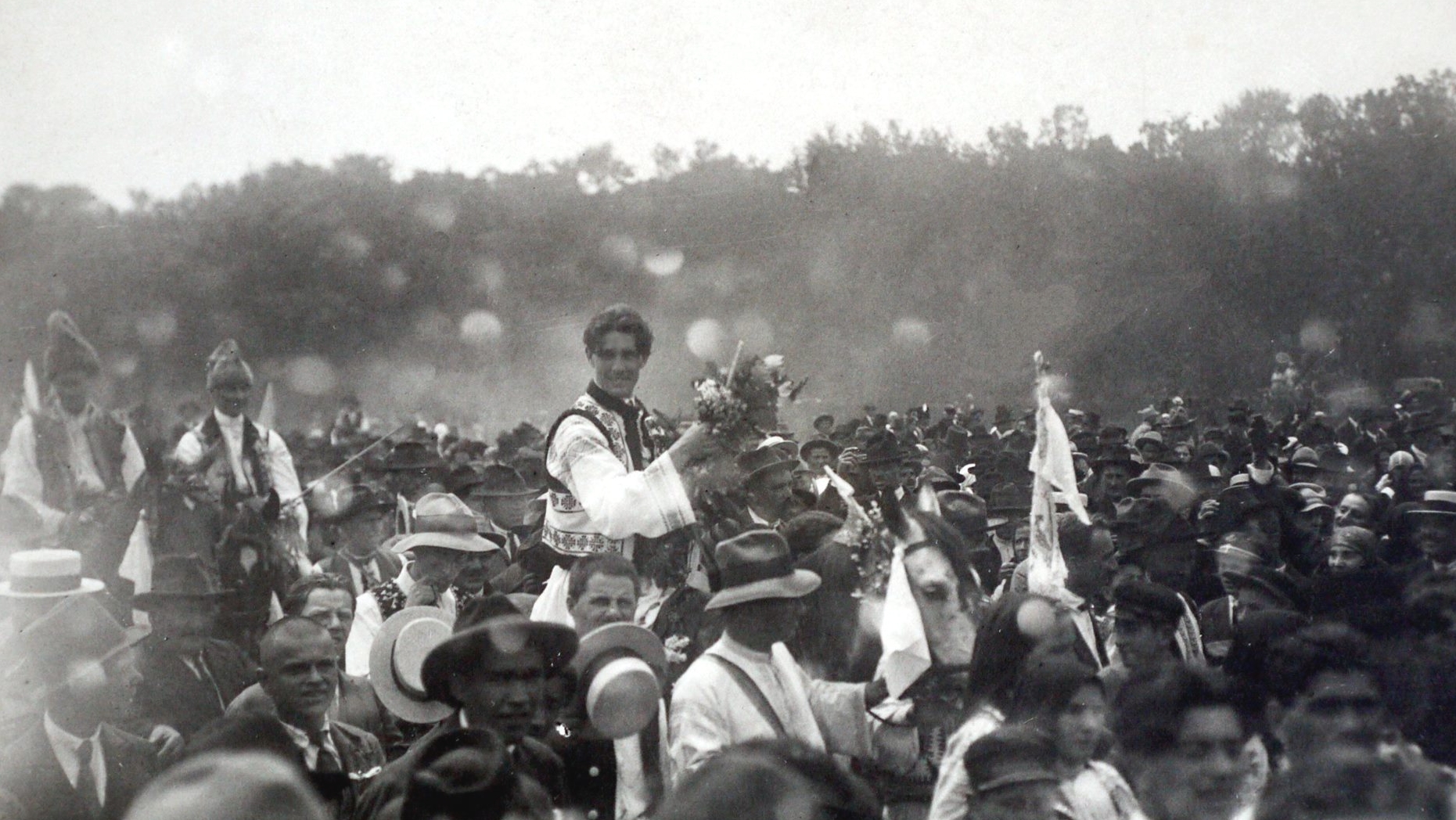
CODREANU’S FAMILY AND ETHNIC CONTEXTS OF THE ROMANIAN MOVEMENT
Corneliu Zelea Codreanu was born Corneliu Zelinski on 13 September 1899 in Huși, Vaslui County in the historic region of Moldavia (then part of the Kingdom of Romania). His father, Ion Zelea Codreanu (originally bearing variants of the Slavic name Zelinski/Zilinschi), was a teacher and Romanian nationalist activist from Bukovina (a multi-ethnic province in Austria-Hungary). The father Romanianized the family name to emphasize national identity. His mother, Elizabeth (Eliza) Brunner/Brauner, was ethnically German (Volksdeutsche or German-folk with roots tracing to Bavaria), who converted to Romanian Orthodoxy.
This mixed ancestry of Slavic borderland roots on the paternal side and German on the maternal is typical of the fluid ethnic realities in Romania’s northeastern and eastern frontiers. Moldavia and neighboring Bukovina were historical contact zones with Polish, Ukrainian, Russian, German, and large Jewish populations. Codreanu grew up in a family that strongly embraced Romanian national ethno-sociological expression despite these origins. His father’s activism and the family’s Orthodox faith shaped a worldview centered on Romanian ethnic revival and resistance to perceived foreign influences. Codreanu’s student years in Iași (Moldavia’s cultural center) immersed him however in a region with deep traditions of Romanian nationalism and antisemitism, including earlier movements led by figures like A.C. Cuza.
This personal background of borderland mixed heritage, consciously subordinated to fervent Romanian Orthodoxy and nationalism, mirrors the movement’s appeal to Romanians navigating identity in multi-ethnic spaces.
ROMANIAN ETHNIC AND NATIONAL IDENTITY
Romanians trace their ethnogenesis to the Daco-Roman synthesis: the Roman conquest and colonization of Dacia (modern Transylvania and surrounding areas) in the 2ⁿᵈ century CE, blended with local Dacian elements and later Slavic, migratory, and Byzantine influences. The dominant narrative emphasizes Latin linguistic and cultural roots (Romanian as a Romance language) alongside Eastern Orthodox Christianity as the national faith, distinguishing Romanians from Catholic Hungarians, Protestant Germans, or Slavic neighbors.
The Orthodox Church became a pillar of ethnic cohesion, especially in the principalities amid centuries of foreign domination into the 19ᵗʰ century periods of national awakening with the Unification of Moldavia and Wallachia (1859), independence (1877-1878), and Kingdom status (1881). By the early 20ᵗʰ century, Romanian nationalism stressed ethnic homogeneity, Orthodox spirituality, and “Romania for Romanians” to combat cultural dilution.
The decisive context came with Greater Romania after World War I. Through the treaties of 1919-1920 (Trianon, Saint-Germain, etc.), Romania more than doubled in size and population reaching 18 million on the 1930 census. This sudden expansion created acute ethnic anxieties. Romanians, long a subject people in many regions, now ruled over substantial minorities who were often economically or educationally advantaged in urban centers and professions. Jews were particularly visible in commerce, finance, medicine, law, and universities (overrepresented relative to population share due to urban concentration and historical restrictions pushing them into portable trades). Hungarians in Transylvania retained cultural and economic influence. High Jewish urban presence amplified perceptions of “invasion” in universities and the economy. Germans (Saxons) had historic privileges. In a predominantly agrarian, poor society recovering from WWI destruction and hit by the Great Depression, rural Romanians and aspiring middle classes encountered urban minorities (especially Jews in Moldavia and cities) as competitors or perceived exploiters. Land reform redistributed estates but often failed to satisfy peasants fully.
Fears of revisionism with Hungary seeking Transylvania back, the Soviet Union claiming Bessarabia, and “internationalist” ideologies such as communism (seen as connected to some Jewish revolutionaries) grew. As was the case in Italy, liberal democracy and old political parties were viewed as corrupt, weak, or serving elite-foreign interests.
THE MYSTICAL PHILOSOPHY OF THE ROMANIAN LEGIONARIES
The Legion drew primarily from ethnic Romanian youth such as students, peasants, small-town lower middle class, and some intellectuals, rather than the old elites. Its root support was strongest in Moldavia (Iași-centered), with spread to Wallachia and parts of Transylvania. Supporters were overwhelmingly Romanian Orthodox, male, and younger generations disillusioned with the status quo. It provided them a clear narrative of ethnic self-assertion and purification in a multi-ethnic state where Romanians felt economically and culturally challenged despite political majority status (The “Majority Question” in Interwar Romania). The movement’s “new man” ideal and comradeship in struggle provided psychological and social empowerment for ethnic Romanians navigating the insecurities of Greater Romania’s incomplete national revolution.
Legionary philosophy and metaphysics, according to Corneliu Zelea Codreanu in his For My Legionaries (Pentru Legionari, 1936) and The Nest Leader’s Manual (Cărticica șefului de cuib, c. 1933) center on spiritual and moral regeneration rather than political programs or material goals. The movement presents itself as a school for forging a “new man” through small-group discipline (“nests”), Orthodox Christian faith, and inner transformation. The nation is viewed as an eternal, God-given entity with a specific historical destiny and mission that extends beyond earthly life into resurrection and the invisible-spiritual realm.
Codreanu repeatedly stresses that Romania suffers from a lack of men of character, not from a lack of programs. The Legion integrates Christian mysticism with a form of national mysticism: direct, lived contact with the “soul of the race” by leaping beyond personal and material interests.
The aim was the creation of a heroic, spiritually superior human type through rigorous moral and spiritual formation:
“From this Legionary school a new man will have to emerge, a man with heroic qualities; a giant of our history to do battle and win over all the enemies of our Fatherland, his battle and victory having to extend even beyond the material world into the realm of invisible enemies, the powers of evil. Everything that our mind can imagine as more beautiful spiritually; everything the proudest that our race can produce, greater, more just, more powerful, wiser, purer, more diligent and more heroic, this is what the Legionary school must give us! A man in whom all the possibilities of human grandeur that are implanted by God in the blood of our people be developed to the maximum.”
The nest system builds self-control, moral purity, work, faith, hierarchy, and discipline to produce this type, i.e., heroes ready to fight, sacrifice, and die for the homeland’s flowering and strength.
NATIONAL MYSTICISM AND THE SOUL
Faith and prayer are not peripheral but decisive forces that connect the individual and nation to higher powers:
“If Christian mysticism and its goal, ecstasy, is the contact of man with God through a leap from human nature to divine nature, national mysticism is nothing other than the contact of man and crowds with the soul of their race through the leap which these forces make from the world of personal and material interests into the outer world of race. Not through the mind…but by living with their soul.”
Prayer attracts spiritual support:
“Prayer is [a] decisive element of victory. Wars are won by those who have managed to attract from elsewhere, from the skies, the mysterious forces of the invisible world and to secure their support. These mysterious forces are the souls of the dead, the souls of our ancestors…But, above the souls of the dead, there is God…victories do not depend only on material preparation…but on their power to secure the support of spiritual forces. The fairness and the morality of actions and the fervent, insistent call for them in the form of rite and collective prayer attract such forces.”
The individual exists within a larger framework:
“The individual in the framework and in the service of his race, the race in the framework and in the service of God and of the laws of the divinity.”
Legionaries are called to inner death and rebirth:
“We will kill in ourselves a world in order to build another, a higher one reaching to the heavens.”
This outlook encompasses history, eternity, and the invisible realm. Victories and national life depend on alignment with spiritual forces and God’s laws. The movement seeks Romania’s resurrection after “centuries of darkness,” sounding a divine trumpet for a new spiritual era. Suffering purifies and advances the people; a “dry and infertile soul” world dies while a new one of faith is born.
Nae Ionescu (a philosopher who lectured on metaphysics and influenced the broader intellectual milieu around the Legion) described the Legionary phenomenon as a comprehensive “spiritual formula” containing the entire manifestation of life in history and eternity. It would birth a new political, economic, and spiritual civilization emerging from the decadence of the present age. It is a call to inner heroic transformation, lived faith, sacrifice for eternal national destiny, and alignment with invisible spiritual powers, aimed at resurrecting Romania as a nation fulfilling its God-given mission.
FASCIST CHARISMATICS AND SPIRITUALITY
Nicholas Nagy-Talavera was a Hungarian American of Jewish descent, a historian and dissident. The historian recounts the day he met Codreanu, describing him as a charismatic man, childlike and radiant, in whom he could see nothing evil in:
“There was suddenly a hush in the crowd. A tall, darkly handsome man dressed in the white costume of a Rumanian peasant rode into the yard on a white horse. He halted close to me, and I could see nothing monstrous or evil in him. On the contrary. His childlike, sincere smile radiated over the miserable crowd, and he seemed to be with it yet mysteriously apart from it. Charisma is an inadequate word to define the strange force that emanated from this man. He was more aptly simply part of the forests, of the mountains, of the storms on the snow-covered peaks of the Carpathians, and of the lakes and rivers. And so he stood amid the crowd, silently. He had no need to speak. His silence was eloquent; it seemed to be stronger than we, stronger than the order of the prefect who denied him speech. An old, whitehaired peasant woman made the sign of the cross on her breast and whispered to us, “The emissary of the Archangel Michael!” Then the sad little church bell began to toll, and the service which invariably preceded Legionary meetings began. Deep impressions created in the soul of a child die hard. In more than a quarter of a century I have never forgotten my meeting with Corneliu Zelea Codreanu.”
Hungarian Jewish historian, Nicholas Nagy-Talavera
Iron Guard leader, Corneliu Zelea Codreanu played leadership roles in a number of political organizations in his early career, from “The Guard of the National Conscience,” the “League of National Christian Defence,” the “Legion of the Archangel Michael,” and finally, the Iron Guard.
Codreanu mirrors Giovanni Gentile when he wrote in For My Legionaries, that:
“Legionary life is beautiful, not because of riches, partying or the acquisition of luxury, but because of the noble comradeship which binds all Legionaries in a sacred brotherhood of struggle.” (Codreanu, For My Legionaries)
Giovanni Gentile explained in his lecture (March 8, 1925) on What is Fascism, that Fascism is a political doctrine, that takes into account the totality of life:
“Gentlemen: Fascism is a party, a political doctrine. But Fascism, while being a party, a political doctrine is above all a total conception of life. So the fascist, whether his is writing in newspapers or reading them, going about his private life or talking to others, looking to the future or remembering the past and the past of his people, must always remember he is a Fascist. Thus he fulfills what can really be said to be the main characteristic of Fascism, to take life seriously. Life is toil, is effort, is sacrifice, is hard work.” (Che cosa è il fascismo: Discorsi e polemiche, “What is Fascism?”, Florence: Vallecchi, 1925, pp. 38-39)

CODREANU SCAPEGOATS THE JEWS
Post-1918 Greater Romania incorporated territories with substantial Jewish populations (higher concentrations in cities like Iași, Bucharest, and especially Bessarabia/Bukovina). Jews, making up 4-5% nationally were disproportionately urban, educated, and active in commerce, finance, professions, and universities. In a poor, largely agrarian society recovering from WWI devastation and battered by the Great Depression, this fueled perceptions of Jews as exploitative middlemen, competitors, or barriers to Romanian social mobility. 1920s student protests (including early Codreanu involvement) demanded numerus clausus (ethnic quotas) amid university overcrowding and claims of “Jewish invasion.”
Therefore, Codreanu’s goal within these movements, as he believed, was to defend the newly established Greater Romania against those he considered the enemies, namely, the Soviet Union and the Jewish people. The 1917 Bolshevik Revolution and subsequent communist upheavals (e.g., in Hungary) created widespread dread of subversion. Some prominent revolutionaries had Jewish backgrounds, which nationalists amplified into a “Judeo-Bolshevik” conspiracy. Annexed eastern territories with large Jewish communities were viewed as potential Soviet fifth columns. Legionaries positioned their Christian-nationalist struggle as defense against the dual threat of capitalist exploitation and communist internationalism.
Romania was framed as an Orthodox Christian nation with a distinct “national soul” rooted in land, faith, and tradition. Jews were cast as perpetual outsiders with alien religion, customs, and allegedly materialist values incompatible with Legionary mysticism and sacrifice. Longstanding Eastern European antisemitic folklore and tropes provided fertile ground for the movement. The Legionary movement has been described as unusually morbid, and a “death cult,” blending nationalistic violence and fanatical Christian martyrdom.
Texts like The Protocols of the Elders of Zion circulated widely and portrayed Jews as a coordinated international force undermining nations through liberalism, capitalism, or communism. This aligned neatly with Codreanu’s worldview of a cosmic-spiritual battle against “powers of evil” and material corruption opposing Romania’s resurrection and God-given destiny. Solving the “Jewish problem” was presented as part of the new hero’s mission. Codreanu was eventually assassinated by the state’s police during his imprisonment.
Jordan Meale’s paper, “The Romanian Iron Guard: Fascist Sacralized Politics or Fascist Politicized Religion (Occasional Papers on Religion in Eastern Europe: Vol. 36: Issue. 5, Article 6) gives us historical context before the Romanian Iron Guard in the eighteenth and nineteenth-century.
An article, The Legionary Movement in Romania by Alexander E. Ronnett, M.D. & Faust Bradescu, Ph.D. analyzes the attitudes taken by others regarding attempts to thoroughly engage in this research.
“It is the authors’ observation that most people make the mistake of not considering socio-political phenomena in their natural context in order to discover the legitimate causes, the true sense of their development, and especially their importance in the environment which fostered them. Carried away by the passion of political convictions or by the hope of immediate benefits, they reduce every phenomenon to a linear problem: good or bad, to be accepted or rejected.
Moreover, governments, the authorities, “reason” in the same manner. This maintains an atmosphere of suspicion and misunderstanding and is detrimental to the awakening of consciousness to what we believe are certain essential truths.
This disposition of the public to a puerile partisanship is manipulated by those who are interested in compromising, or even in annihilating, a historical, political, or social truth. They know that the mass man reduces everything to his personal conception, considering as false and dangerous anything which does not conform to his thoughts; (…) is incapable of placing himself in the socio-historical context of the phenomenon in order to judge it according to reality, nor does he manage to make abstraction from his own reality, and comparisons are reduced to what seems just and perfect in relationship to himself; (…) and is influenced by what the press disseminates without ever being able to perceive the lies, exaggerations and perfidious insinuations which infest most of these communications.
Therefore, playing upon these attitudes of the mass man, it is easy for dishonest people to direct even the most liberal and intelligent opinion and to lead the most honest and just people into error.”
As the article argues, Codreanu has a particular critique about modernity, liberalism and democracy.
“Anyone wishing to conquer a people could do it by using this system: Breaking its ties with heaven and land, introducing fratricidal quarrels and fights, promoting immorality and licentiousness, by material ruin, physical poisoning, drunkenness. All these destroy a nation more than being blasted by thousands of cannon or bombed by thousands of airplanes.”
It is true, that nations are capable of destroying themselves from within, but the real underlying context to his thoughts is who in particular Codreanu believes is behind this system he argues is destroying Romania, severing its people from their roots, and from advancing as a people and nation.
Regarding Codreanu and Jewish treatment in Romania, the rationale of Codreanu’s thought and direct statements against Democracy is almost entirely based on a belief in a struggle between the Romanian state and the Jews. This rationale on the issue justified discrimination, and the taking of private ownership, land and rights from Jews in Romania, even physically attacking Jewish communities.
Although Giovanni Gentile’s writings did not contain antisemitism, he pushes against the belief, that Fascism is a barbarous ideology. Gentile put the question to his audience in his 1925 lecture in Florence (ibid): “How many times has Fascism been accused with obtuse malevolence of barbarity?” Codreanu’s Romanian Fascism however follows the very logic of Gentile’s thoughts in its aim to restore the health of Romania, but by eliminating the scapegoat, the Jew. Gentile continues, “Well yes: once you understand the true significance of this barbarity we will boast of it, as the expression of the healthy energies which shatter false and baleful idols, and restore the health of the nation within the power of a State conscious of its sovereign rights which are its duties.”
These lyrics and songs give us insight into the manner in which Fascism in general and the Romanian Iron Guard was able to influence and galvanize men and relate to their deepest aspirations.
Sfânta tinerețe legionară translated as Holy Legionary Youth was a militant patriotic hymn and unofficial anthem of the youth wing of the Romanian Iron Guard (Garda de Fier), also known as the Legion of the Archangel Michael or Legionary Movement. It was one of several legionary songs used to inspire and rally members during Romania’s interwar period (c. late 1920s-early 1940s), performed at legionary gatherings, funerals, and events.
A choral rendition sung by nuns (maicile) from the Petru Vodă Monastery in Romania.
Sfânta Tinerețe Legionară idealize disciplined, self-sacrificing “legionary youth” with an iron-hardened chest/resolve (“piept călit de fier”), a pure lily-like soul (“sufletul de crin”), spring-like unstoppable vigor (“iureș ne-nfrânat de primăvară”), and Carpathian mountain-like strength/forehead. It emphasized fighting for the “Captain” (Corneliu Zelea Codreanu, the movement’s founder and charismatic leader), the country, the Orthodox Christian faith and cross, building altars while reserving “bullets only for traitors,” and embracing “legionary death” as the highest honor. It mixes Orthodox mysticism, Romanian nationalism, and a cult of youthful vitality and martyrdom. It was written by Radu Gyr (pen name of Radu Ștefan Demetrescu, 1905-1975), a Romanian poet, essayist, journalist, and active legionary who served as a regional commander (Oltenia) in the mid-1930s. He authored multiple legionary hymns and propaganda pieces. It was composed by Ion Mânzatu, a professional songwriter who collaborated with Gyr on other legionary works, e.g., the 1937 “Hymn to the Heroes Moța and Marin” below.
It taps into longer Romanian romantic nationalism, Orthodox revivalism, peasant mysticism, and a “cult of youth” or vitalism common in early 20ᵗʰ century European thought, but the hymn itself is a product of the fascist Legionary context (Francesco Zavatti, Transnationalizing fascist martyrs: an entangled history of the memorialization of Ion Moţa and Vasile Marin in Spain and Romania, 1937–41).
Sfânta tinerețe legionară LYRICS
| Sfânta tinerete legionara, | Holy young Legionary, |
| Cu piept calit de fier si sufletul de crin | With a chest like iron and a soul like a lily |
| Iures ne-nfrânat de primavera, | Unbridled he rushes in spring, |
| Cu fruntea ca un iezer carpatin, | With a forehead like a Carpathian waterfall, |
| Cu bratele suim în soare | With arms going up in the sun |
| Catapetesme pentru veac; | [An] eternal Iconostasis; |
| Le zidim din stânci, din foc, din mare | We built it from rocks, from fire, from the sea |
| Si dârz le tencuim cu sânge dac… | And stoutly we daubed it with Dacian blood… |
| Garda, Capitanul | The Guard, the Captain |
| Ne preschimba-n soimi de fier | We transformed into iron hawks |
| Tara, Capitanul | The Country, the Captain |
| Si Arhanghelul din cer. | And the Archangel from heaven. |
| Moartea, numai moartea legionara | Death, only death Legionary |
| Ne este cea mai scumpa nunta dintre nunti, | It is the most costly wedding of weddings, |
| Pentru sfânta cruce, pentru tara | For the holy cross, for the country |
| Înfrângem codrii si supunem munti; | We will defeat the forests and make the mountains obey. |
| Nu-i temnita sa ne-nspaimânte, | There is no prison that can scare us |
| Nici chin, nici viforul dusman; | No pain, no enemy storm; |
| De cadem cu toti, izbiti în frunte, | If we all fall, struck in the forehead, |
| Ni-i draga moartea pentru Capitan! | Death is dear to us for the Captain! |
| Garda, Capitanul | The Guard, the Captain |
| Ne preschimba-n soimi de fier | We transformed into iron hawks |
| Tara, Capitanul | The Country, the Captain |
| Si Arhanghelul din cer. | And the Archangel from heaven. |
| Sfânta tinerete legionara, | Holy young Legionary, |
| Suim biserici, stam viteji în închisori… | We build up churches and stay brave in prison… |
| În prigoana orisicât de-amara | In persecutions all who are bitter |
| Cântam si ne gândim la Nicadori, | Sing and think of the Nicadori, |
| Purtam în crivat si în soare | We carry in blizzard and in sun |
| Lumini pentru biruitori, | Lights for victors, |
| Pentru cei viteji zidim altare | For the brave we build altars |
| Si-avem doar gloante pentru tradatori! | And for traitors we have only bullets! |
| Garda, Capitanul | The Guard, the Captain |
| Ne preschimba-n soimi de fier | We transformed into iron hawks |
| Tara, Capitanul | The Country, the Captain |
| Si Arhanghelul din cer. | And the Archangel from heaven. |


The Hymn of the Legionary Youth and Mota-Marin tell us of battle between political forces and the brotherhood of the Romanian Iron Guard cult.
The Hymn of Mota-Marin, in 1936, the Romanian Legionnaire Ion Moța led a team of seven Legionnaires to assist general Francisco Franco in fighting the Spanish Civil War against the Spanish Republican faction of Anarchists and Marxists. In the battle at Majadahonda in Spain on January 13th, Moța and Marin both died after being hit by gunfire.

General Franco made Moța and Marin martyrs, erecting a monument on the spot of their death.
IMNUL MOTA-MARIN LYRICS
| Imnul Mota-Marin | The Hymn of Mota-Marin |
| Sunt ruguri de flacari. E Spania-n scrum. | There are pyres and flames, Spain is in ashes… |
| Gloantele cad în altar. | Bullets fall on the alter. |
| În negrele santuri cu sânge si fum, | In black ditches with blood and smoke |
| Ploua cu schije si jar. | There rains shrapnel and fire. |
| Dar sub obuze, | But under the bombs, |
| Gloante si spuze, | Bullets and heaps, |
| Par legionarii niste munti… | Appear the Legionaries like mountains… |
| Ranita-n zare, | Injured on the horizon |
| Crucea le-apare | The Cross appears |
| Si ceru-i mângâie pe frunti. | And asked it for comfort on the forehead. |
| Noaptea-n transee legionarii, | At night in trenches Legionaries |
| În ploaie îsi fac rugaciunea… | In the rain make their prayer… |
| Mintea lor trece fruntarii | Their dreams move across frontiers |
| Si-n gând li s-aprinde Legiunea, | And in their thought the Legion flashes |
| Si vad Capitanul si tara | And they see the Captain and country |
| Cu sfântu-i destin legionar. | With the saintliness of Legionary destiny. |
| Obuzele tuna, împroasca otel… | The shells thunder, steel splashes… |
| Tancuri pornesc ca din iad. | Tanks start as if from hell. |
| Si Mota e-n frunte, Marin lânga el | And Mota in front, Marin next to him, |
| Rosii, grenadele cad… | Red garnets fall… |
| Printre retele, | Among networks, |
| Mine, srapnele, | Mines, shrapnel, |
| Schijele ploua fier de sus. | Splinters raining from above…. |
| Loviti în frunte, | Struck in the forehead, |
| Cu bratele frânte, | With their arms broken, |
| Cad legionarii lui Iisus. | Legionaries fall by Jesus. |
| Mota în sant plin de sânge, | Mota, in the ditch, full of blood, |
| Sopteste murind rugaciunea: | Whispered, while dying, a prayer: |
| “Moartea la pieptu-i ne strânge | “Death we tighten to our chests |
| Sa creasca mai mândra Legiunea. | So that the Legion will grow more proudly; |
| Sa faci, Capitane, o tara | So that the Captain may make the Country |
| Ca soarele sfânt de pe cer!” | Like the holy sun in the Sky!” |
| Dar jertfele sfinte ard pururi în noi. | But holy sacrifices burn forever in us; |
| Jertfele ne-au mântuit, | Sacrifices have saved us. |
| Si cresc din morminte martirii eroi, | And martyred heroes rise from the grave |
| Neamul se-nalta sfintit. | The Nation rises sanctified. |
| Legiunea-ntreaga, | The Legion as a whole |
| Jurând se leaga, | Swearing and bound |
| Ca sa urmeze jertfa lor. | To follow their sacrifice. |
| Din legaminte | From covenant |
| Si din morminte | And holy sacrifice |
| Va creste-un neam biruitor. | Will grow a victorious people. |
| Scumpii eroi ne vegheaza | We watch our beloved heroes |
| Si duc spre lumina Legiunea. | And lead to the light of the Legion. |
| Toti vrem o moarte viteaza, | We all want a brave death, |
| Ca ei ne soptim rugaciunea: | Like they we whisper our prayer: |
| “Sa faci, Capitane, o tara | “So that the Captain may make the Country |
| Ca soarele sfânt de pe cer!” | Like the Holy Sun in the sky!” |
| Azi sfintele oase le-am pus temelii | Today, we put the holy bones in the ground |
| Vajnice neamului dac, | Eternal, with the Nation, |
| Si ele înfrunta de-acum vesnicii, | And from now they face eternity, |
| Stânci tencuite cu veac… | Rocks plastered with age. |
| Dar de-or sa vie | But they will live when there will come |
| Vremi de urgie | Times of scourge |
| Pentru destinul legionar, | For Legionary destiny |
| Din oseminte | From the bones |
| Si din morminte | And holy sacrifice |
| Cei doi eroi vor creste iar! | The two heroes will rise again. |
| Mota, Arhanghel si munte, | Mota, Archangel and mountains |
| Marin ca o flacara mare. | Marin like a great flame, |
| Cu Capitanul în frunte | With the Captain in front |
| Ne-or duce în viscol de soare: | We will go through storm or sun; |
| “Sa faci, Capitane, o tara | “So that the Captain may make the Country |
| Ca soarele sfânt de pe cer!” | Like the Holy Sun in the sky!” |
Codreanu’s story, his mystical Orthodox theology and the Legion reflect Romania’s unique position as a Latin-Orthodox people with borderland ethnic fluidity, emerging from long subjugation into a suddenly enlarged but fragile multi-ethnic state.
This philosophy reflects republican civic virtue but radicalizes it into a spiritual-palingenetic (rebirth) project. Republics were not purely abstract or universalist, as historical examples often rested on ethnic and cultural cores with civic myths. Romanian Legionaries adapted, synthesized, and politicized the spiritual-palingenetic (regeneration or rebirth) motif in a modern nationalist form, though this idea has its precedents in antiquity. Republican thought classically emphasizes cycles of corruption and virtuous renewal (e.g., Polybius’ anacyclosis or Machiavelli’s calls for periodic return to founding principles). The stages of American republican collapse and recovery of pre-Marxist radical traditions, as much as the history of the Legionary provide a stark European example of how renewal impulses have manifested when liberal republican institutions appear corrupt, materialist, or spiritually hollow. Studying this history helps clarify what healthy civic regeneration looks like versus its illiberal competitors and distortions; and explains what emerges amidst the failures of liberal democracy, economic crisis and corrupt parties. Codreanu’s movement provided a concrete European case of how spiritual philosophy can underpin national and civic life.
Legionarism arose partly as a response to Romania’s interwar republican and liberal weaknesses, offering spiritual-nationalist answers (sacrifice for patria, eternal destiny, anti-materialism) where procedural republicanism faltered. It serves as a warning, that without robust civic virtue, spiritual depth, and attention to ethnic-cultural realities, republics can face radical challenges from movements promising rebirth.

