HAS THE HISTORY OF SCIENCE BEEN REWRITTEN: RECLAIMING PRE-SOCRATIC, ISLAMIC AND METAPHYSICAL ROOTS IN THE SECULAR ENLIGHTENMENT NARRATIVE, AND ITS IMPLICATIONS FOR MODERN RELATIONSHIP OF SCIENCE, PHILOSOPHY AND RELIGION
This piece was originally a final research paper for REL 302/PHL 327 at DePaul University for Winter Quarter (Jan-Mar 26′), continuing investigation into the secular enlightenment and omitted lineages and contributions in the narrative of Western Philosophy, and the consequences of those omissions.
——————————————————
INTRODUCTION
The Western narrative of the Age of Enlightenment has systematically rewritten the history of science by sanitizing its metaphysical, religious, and non-European roots, particularly pre-Socratic natural philosophy and classical Islamic transmissions1, i.e., physis-centered noetic traditions. This history portrays scientific progress as a purely rational, secular, and individualistic triumph of modernity, while downplaying cyclical, integrative, and noetic traditions. As Terence Keel2 demonstrates, this sanitized history hides how Christian theological patterns of creation and monogenism were reoccupied into modern racial science, enabling Eurocentric hierarchies that denied philosophical agency to non-Western lineages (Keel 23-24). William Rasch3 further reveals the Enlightenment as a quasi-religious formation that reoccupies theological absolutes with secular dogmas of autonomous reason (Rasch 177). David Sorkin4 complicates this by recovering the “Religious Enlightenment” strands that included non-Protestant contributions. Through examination of Islamic preservationist scientific and philosophical contributions to Baron d’Holbach’s material determinism (reflecting Greek cyclical anankē) and Joseph Boscovich’s point-particle theory (reviving Pythagorean unified physics), this paper argues that such revisions create an illusory dichotomy between science and religion. Reclaiming these erased contributions through the hermeneutic recovery of the ancient Greek concept of physis as dynamic generative order reveals science and religion as complementary noetic inquiries into natural laws, cosmic justice and ethical self-mastery, thereby providing a nuanced perspective on myth and narrative, cross-cultural comparison, moral dimensions in racial ethics, textual interpretation, cultural interaction and religion’s societal power dynamics. This analysis draws on close textual interpretation, cross-cultural comparison, and historical genealogy.
- INTRODUCTION
- METAPHYSICAL FOUNDATIONS: PRE-SOCRATIC INTEGRATIVE NOETIC WISDOM AND ERASURE IN WESTERN NARRATIVES
- CLASSICAL ISLAMIC CONTRIBUTIONS TO SCIENTIFIC THINKING: HERMENEUTIC PRESERVATION, ONTOLOGICAL SYNTHESIS AND OMISSION FROM ENLIGHTENMENT LEGACY
- ANCIENT NOETIC UNIVERSALISM AND REFUTATION OF RACIAL HIERARCHIES
- BLUMENBACH AND THE REOCCUPATION OF CHRISTIAN MONOGENISM IN ENLIGHTENMENT SCIENTIFIC RACISM
- ENLIGHTENMENT RECONFIGURATIONS: D’HOLBACH, BOSCOVICH AND THE SANITIZATION OF METAPHYSICAL ROOTSS
- IMPACT
- WORKS CITED
——————————————————
METAPHYSICAL FOUNDATIONS: PRE-SOCRATIC INTEGRATIVE NOETIC WISDOM AND ERASURE IN WESTERN NARRATIVES
Before any sanitized “history of philosophy” began, the pre-Socratics operated as holistic wise men who never separated science from ethics, myth or the divine. They functioned as integrative prophets whose ideas were inseparably tied to ethical community living and contemplative insight. PHYSIS, Heraclitus famously declared, is the living, generative process that “loves to hide.” It unfolds and conceals simultaneously, demanding both empirical observation and contemplative insight (Heraclitus Fragment 123). Thales predicted eclipses while seeing water as the fundamental archē; Anaximander envisioned the apeiron as an infinite source regulated by dikē (justice), where things pay penalty for their injustice in cyclical time; Heraclitus taught that all is flux yet unified by LOGOS; and Pythagoras combined mathematics, music and moral discipline into a single way of life.
This integrative vision, which is cyclical, noetic and inclusive directly parallels and challenges the Eurocentric hierarchies Keel critiques, where Christian residues privileged “pure” European rationality, while erasing metaphysical depth in archaic traditions (Keel 24). The moral lesson is clear: cosmic justice as natural balance (dikē) stands in contrast to the racialized hierarchies of progress that Enlightenment science would later invent. PHYSIS is not static “nature,” but the self-unfolding, self-concealing generative process of reality itself, revealing a dynamic order that integrates myth, ritual, symbol, ethics and cosmic law. This noetic universalism carried a powerful moral dimension that modern scholarship often fails to recover with cosmic justice as natural balance, rather than later racialized hierarchies of progress. This metaphysical depth was marginalized in the sanitized narrative, setting the stage for Blumenbach’s reoccupation of Christian monogenism into secular exclusion, while effacing the universal cosmology and ethics that had refused fixed biological or racial hierarchies.
——————————————————
CLASSICAL ISLAMIC CONTRIBUTIONS TO SCIENTIFIC THINKING: HERMENEUTIC PRESERVATION, ONTOLOGICAL SYNTHESIS AND OMISSION FROM ENLIGHTENMENT LEGACY
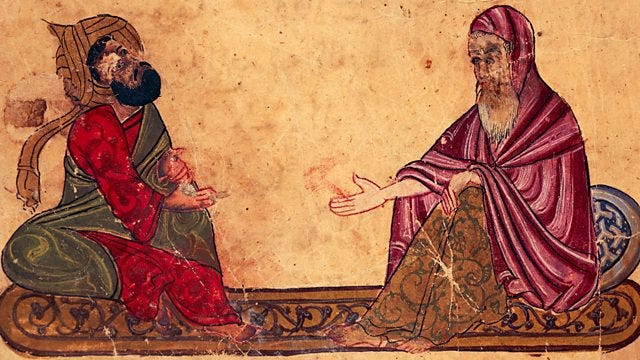
Far from being a mere bridge, classical Islamic philosophy (8th-14th centuries) performed a profound hermeneutic recovery that kept physis alive. Centered in Baghdad’s Bayt al-Hikma during the Abbasid translation movement, scholars translated and commented on Thales, Anaximander, Heraclitus, Plato’s Timaeus, Pythagorean harmonics and Plotinus, often providing their own ontological depth. This tradition combined Greek noetic inquiry with the Qur’anic command to contemplate the cosmos (Surah 30, 35.41 and 48:48), sustaining integrative epistemologies where LOGOS and divine necessity converged. Many Islamic frameworks remained integrative and cyclical, prioritizing contemplative self-mastery, introspection and cosmic justice over autonomous reason or electoral individualism. Mystical cosmologies and their connection to musical harmony and theories of force were largely lost in the Enlightenment’s mechanization and secularizing process of ancient concepts but survived in Islamic and Scholastic undercurrents.
A key effort in synthesis include: al-Kindī’s integration of Greek thought in On First Philosophy, al-Farabi’s noetic political ontology fusing Plato and Aristotle, Avicenna’s essence-existence distinction and theophanic view of nature in the Canon of Medicine framing nature as divine signs, Averroes’ exhaustive line-by-line commentaries on Aristotle’s Physics and Metaphysics preserving causality and motion for transmission through Latin Averroism, and Ibn al-Haytham’s controlled experimental optics with intromission theory treating light as active form. Without this lineage, following transmissions from 6th-5th BCE Pre-Socratic Greece to the Abbasid Baghdad synthesis (750 CE-1258 CE), then 12th CE Toledo and Sicily to the Latin West, the post-Roman revival simply could not have happened.
Yet Euro-centric control later erased their agency, exactly as Keel and Rasch describe in the construction of Western superiority (Keel 24; Rasch 117). This omission denied philosophical agency to Islamic universalism, which like pre-Socratic and Stoic traditions, refused fixed racial hierarchies in favor of noetic cosmopolitanism, directly prefiguring the Blumenbachian pinnacle that would biologize exclusion.
This hermeneutic recovery was no mere passive transmission, but an active ontological synthesis that directly engaged the ancient Greek naturalist thought within a Qur’anic contemplative model. As Dimitri Gutas demonstrates in his authoritative study of the Graeco-Arabic translation movement, the ‘Abbasid project systematically preserved and expanded nearly the entire Greek corpus, including doxographies on the ancient naturalists through works like the Placita of pseudo-Plutarch, allowing Islamic philosophers to confront Thales’ archē, Anaximander’s dikē-governed cyclical APEIRON, and Heraclitus’ unifying LOGOS not as antiquarian relics, but as living resources for metaphysical inquiry (Gutas 1998). Seyyed Hossein Nasr further reveals how this engagement transformed Islamic philosophy into a distinct tradition. Islamic thinkers, especially in the Illuminationist (ishrāqī) school, revered Pre-Socratic (Greek naturalist) sages such as Pythagoras, Parmenides and Empedocles as prophetic figures whose insights into cosmic unity and emanation reflected the Qur’anic cosmos, thereby sustaining a noetic universalism that integrated empirical science with ethical self-mastery and refused any fixed biological or racial hierarchies (Nasr 2006).
Complementing these analyses, the scholarly consensus in sources like the Standard Encyclopedia entry on Greek sources in Arabic Philosophy prove that without this creative reworking, evident in al-Kindī’s circle and the theology of Plotinus and Aristotle, Western Scholasticism and the Renaissance would have lacked the foundational texts that later fueled Enlightenment reconfigurations. The very lineages enabling this transmission were racially effaced in modern narratives, according to Greek Sources in Arabic and Islamic Philosophy (2015). Islamic philosophy not only preserved vision of PHYSIS as dynamic generative order but enacted a cosmopolitan ethics that directly challenges the Enlightenment’s retroactive racialization of philosophy, exposing the denial of agency that Blumenbach’s taxonomy would later institutionalize.
——————————————————
ANCIENT NOETIC UNIVERSALISM AND REFUTATION OF RACIAL HIERARCHIES
Before the Enlightenment invented “Western Philosophy” as a racially superior lineage, ancient thinkers practice noetic universalism that saw all humans as participants in the same cosmic LOGOS. Prior to the Enlightenment’s racialization of philosophy, Pre-Socratic, Stoic and Islamic traditions articulated a universal cosmology and ethics that refused fixed biological or racial hierarchies. Pre-Socratic PHYSIS as dynamic generative order, Stoic concept of logos spematikos (fragment of Zeus) shared by all humanity regardless of origin, and Islamic falsafa’s contemplative synthesis through Qur’anic verses (āyāt) emphasized ethical self-mastery and cosmic citizenship accessible through reason and contemplation alone. This noetic universalism extended contemplative insight and moral balance to every human being, rejecting any essentialized biological or racial superiority in favor of shared participation in the unfolding cosmos.
For instance, Anaximander’s APEIRON governed by Justice (dikē) enforced cyclical equilibrium among all elements and beings without privileging any human group, while Stoics such as Epictetus and Marcus Aurelius declared reason as the divine spark binding all people as citizens of the cosmos. Islamic philosophers like al-Farabi and Avicenna further extended this into a noetic political ontology and theophanic view of nature, where the ideal of philosophical ascendancy and ethical self-mastery transcended lineage or biology. These integrative frameworks sustained cosmopolitan ethics that prioritized cosmic justice and contemplative unity over exclusionary essence, directly countering the later construction of discreet, superior “Western” lineages.
Lynn White Jr. mediates the contrast by arguing how Christianity’s triumph over paganism instituted a radical anthropocentrism and dualism absent in the very traditions that preceded it. As White observes, “Christianity, in absolute contrast to ancient paganism (…) and Asia’s religions, not only established a dualism of man and nature” (White 2) but insisted that it is God’s will for man to exploit nature for the ends of men. This hierarchical worldview rooted in scriptural dominion and linear teology secularized into the monogenist patterns that Blumenbach later reoccupied; whereas pre-Socratic, Stoic and Islamic cosmologies placed humanity firmly within a non-exploitative, cyclical PHYSIS that refused fixed hierarchies and promoted ethical balance across all peoples (White 4). White’s analysis thus reveals how the pre-Enlightenment noetic universalism of these traditions offered an alternative moral ecology that the Christian-derived racial sciences supplanted, constraining both scientific inquiry and ethical self-mastery.
David Sorkin further complicates this sanitized narrative by recovering the “religious Enlightenment” as a pan-European phenomenon spanning Protestant, Jewish and Catholic traditions that sought reasonable religiosity, natural religion alongside revelation and genuine toleration of minorities, often resonating with the cosmopolitan universalism of earlier noetic lineages (Sorkin 5). These religious strands fostered commitments to toleration and moral progress that preserved integrative epistemologies against secular dogmas, demonstrating the Enlightenment’s compatibility with faith-based universal ethics. Yet, even as Sorkin shows this broader religious continuity, the dominant racialization of philosophy effaced these threads, transforming latent universalism into exclusionary hierarchies that denied philosophical agency to non-European sources.
——————————————————
BLUMENBACH AND THE REOCCUPATION OF CHRISTIAN MONOGENISM IN ENLIGHTENMENT SCIENTIFIC RACISM
There is a nuance that demonstrates the contrast, which I can argue, and this explains, that while early Greek thought (e.g., Plato’s myth of the metals in Republic) contained soul-based hierarchies (gold, silver, bronze classes), these were cosmological and ethical, thus open to philosophical ascent, not fixed by biology or skin color, unlike the Enlightenment’s biologized, exclusionary version rooted in monogenist degeneration that Keel elaborates in detail (Keel 23-45). Pre-Socratic and Islamic ideas emphasized integrative wisdom over rigid hierarchy; and the Platonic seeds of class stratification were amplified by secular modernity into racial and institutional power structures that denied agency to non-European lineages. Blumenbach’s degenerationist taxonomy merely reoccupied Christian monogenism and the Adamic ideal into a secular “Caucasian” pinnacle, imposing slippery racial essences that justified exclusion while denying philosophical agency to the very lineages from which science borrowed.
The ancient noetic traditions that have been discussed articulated a universal cosmology and ethics that refused fixed biological or racial hierarchies, but it also supplied resources for argumentation to later generations to actively dismantle the very racial sciences that Enlightenment thinkers constructed. While Plato and Aristotle introduced elements5 of biopolitics and state-directed population management6, such as selective breeding for civic virtue or natural slavery tied to perceived intellectual capacity, these were framed within cosmological and ethical hierarchies of the soul, rather than immutable biological essences. Stoic cosmopolitanism universalized the concept of the fragment of Zeus as the divine spark shared equally by all humans, irrespective of ethnicity, geography or social status, insisting that ethical self-mastery and citizenship transcended any bodily or lineage-based distinctions. Their ideas on justice and necessity as cyclical forces bound all beings in equitable flux.
This classical universalism also found modern expression among Black American classicists who wielded Greek and Roman thought as instruments of liberation against post-Enlightenment scientific racism. These Black classicists demonstrated through Stoic ideals of shared reason and republican commitments to civic virtue, that the ethical core of antiquity directly contradicted Blumenbach’s degenerationist model and its secularized monogenism, exposing how Enlightenment racial science had distorted ancient philosophy into a tool of exclusion. By recovering the cosmopolitan ethos of Epictetus and Marcus Aurelius, where slavery and freedom were moral states of the soul rather than biological destinies, they refuted the biologized hierarchies that denied philosophical agency to non-European lineages, showing instead that classical thought prefigured egalitarian human rights grounded in pre-Stoic notions of shared humanity and natural law. In the American context, these pre-Stoic roots in the ancient Greek Milesian, Ionian and other schools among the “Pre-Socratics,” informed foundational human-rights language, melding ideas of universal ethical self-mastery and cosmic justice into declarations of equality that stood in direct opposition to the racial exclusions in secular institutions. The ancient concepts were secularized and reconfigured.
Far from idealizing antiquity, this recovery leads to how Enlightenment sanitization selectively amplified the hierarchical seeds in Plato and Aristotle’s philosophy, while suppressing the universalist currents in Stoicism and pre-Socratic thought that early omitted Islamic philosophers important to the narrative of the transmission of scientific knowledge reflected upon. The result was the retroactive racialization of ‘Western Philosophy” that transformed fluid, soul-based distinctions into rigid biological essences, which is the move Keel identifies in Blumenbach’s taxonomy. By reclaiming these legacies, classical philosophy emerges not as a precursor to racism, but as its most potent philosophical refutation, restoring the noetic universalism that Islamic syntheses had preserved and that Enlightenment reconfiguration had occluded. This depth of engagement with antiquity’s anti-hierarchical potential thus strengthens the attempt here to interrogate the illusory science-religion dichotomy, revealing how the erasure of these traditions perpetuated power structures that constrained both domains.
——————————————————
ENLIGHTENMENT RECONFIGURATIONS: D’HOLBACH, BOSCOVICH AND THE SANITIZATION OF METAPHYSICAL ROOTSS
Even the most modern Enlightenment figures secretly carried ancient metaphysical notions. Baron d’Holbach’s System of Nature (1770) claims everything is MATTER in eternal motion governed by unbreakable laws, yet this is simply pre-Socratic anankē dressed in atheist clothing. As Rasch reveals, the Enlightenment did not secularize. The Enlightenment reoccupied theological necessity with new secular absolutes (Rasch 117). Roger Joseph Boscovich’s 1758 Theory of Natural Philosophy replaces solid atoms with mathematical points of force whose interaction curve alternates between intense repulson at close range (preventing collapse), attraction at medium range and Newtonian gravity at distance. This dynamic continuum revives the Pythagorean idea of a unified harmonic physics transmitted through preserved Greek-Islamic lineages and directly anticipates 19th century field theory and evolutionary ideas. As a Jesuit priest, Boscovich embodied a “happy symbiosis of faith and scholarship,” petitioning to remove Copernicus from the Index, illustrating non-antagonistic relations between science and religion (Macke, Vatican Observatory 2019). Official histories later mechanized and sanitized both thinkers, stripping away their metaphysical and cross-cultural roots to fit the triumph of secularism narrative. This is the erasure that entrenched Christian-derived racial exclusions into supposedly “neutral” institutions.
Boscovich’s understanding of the relationship between theology, religion and ancient classical philosophy to science was one of complementarity, rather than opposition and antagonism. As a Jesuit ordained in 1744 and professor of mathematics as the Roman College, he viewed his scientific vocation as an extension of reason endowed by God, where faith and scholarship mutually stimulate each other through open, diversified and synthetic inquiry (Macke 2019). Pope Benedict XVI explicitly celebrated this “happy symbiosis of faith and scholarship,” observing that in Boscovich “there is analysis, there is study of multiple branches of knowledge, but there is also a passion for unity. This is typical of Catholic culture” (Macke 2019, quoting Benedict XVI 2011). Boscovich’s atomic theory, positing a single law of forces across a dynamic continuum, embodied this unity, integrating metaphysical continuity with empirical precision. The reflection of ancient Pythagorean harmonics and the Greek-Islamic legacy of PHYSIS as generative and dynamic order through emergent processes is in Boscovich’s approach. By successfully petitioning Pope Benedict XIV to remove Copernicus from the Index, Boscovich demonstrated that theology need not constrain, but could actively advance scientific progress, reclaiming the very religious agency denied to non-European lineages in Blumenbach’s taxonomy, hence, exposing the illusory dichotomy.
Baron d’Holbach’s material determinism further reveals unexpected resonances with Gnostic, Illuminationist Islamic, Hindu and Buddhist concepts of cyclical time and cosmology, despite his overt atheism. In the System of Nature, the universe consists solely in matter and motion under an “uninterrupted succession of causes and effects” (Paul-Henri Thiry d’Holbach, Stanford Encyclopedia of Philosophy) governed by inexorable natural laws, i.e., eternal necessity without creator or linear teleology. His ideas reflect the ancient concept of anankē and pre-Socratic ideas of flux, while paralleling cyclical cosmologies that reject progressive, monogenist history. As Seyyed Hossein Nasr explains, such cyclical frameworks appear across traditions: Hinduism’s samsara and cosmic rhythms, Buddhism’s recurring kalpas and Islamic Illuminationist (ishrāqī) and Sufi traditions7 that emphasize eternal return to primordial fitrah through cycles of prophecy and nature’s rhythyms. It is where BECOMING manifests as rhythmic regeneration rather than irreversible progress toward a secular or racial pinnacle (Nasr, Religion and the Order of Nature 1996).
Gnosticism in esoteric Islamic thought similarly evoke cyclical emanation and return, and d’Holbach’s secular version just revives the universal noetic ethics of these lineages. Cyclical justice over hierarchical degenerationism operated within an Enlightenment framework that racialized philosophy and denied agency to the very sources it reflected, which we must confidently interrogate with pressure.
——————————————————
IMPACT
These revisions sever inquiry from its noetic antecedents, creating an illusion of secularity, while entrenching Christian-derived racial exclusions that constrain the domains of secularism and religion, that reinforce power structures (Keel 16; Rasch 120; White 2). Lynn White, Jr. Extends this critique to Christian anthropocentrism combined with science, which provided an excuse for the exploitative and violent relationship to PHYSIS or nature and human beings. This precipitated the ecological crisis through the same power structures that racialized philosophy (White 3-4).
Reflections on this recovery of PHYSIS and Islamic integrative epistemologies clarifies the stakes. Science is never purely objective in application, because the sanitized Enlightenment narrative embedded Christian-derived racial exclusions8 into supposedly neutral institutions. The notion of reason in Secularism quietly carries theological absolutes, according to Rasch, that (1) passed into the 19th century development of Liberalism, (2) justified Eurocentric hierarchies, and (3) turned medical and science structures into tools of exclusion and control. The fixed racial power structures in Enlightenment racialization carried the seeds of stratification from Plato’s soul-based hierarchies that secular modernity amplified, but it differs from the cosmopolitan, cosmological ethics of Presocratic and Islamic thought.
By recovering specifically, the ancient Greek concept of PHYSIS as dynamic generative order, Islamic hermeneutic genius, and the underlying metaphysical layers in d’Holbach and Boscovich’s science and philosophy, we unveil the sanitized narrative as a myth that served power, rather than truth. Science and religion emerge as complementary noetic inquiries into natural laws, cosmic justice and ethical self-mastery: one empirically tracing generative emergent order, the other framing it within ethics and cosmic meaning. This view directly addresses the racial exclusions Keel exposes, and the quasi-religious secularism that Rasch critiques, while honoring Sorkin’s views in Religious Enlightenment. The project of reclaiming physis does not idealize Greece but reveals how Enlightenment sanitization transformed philosophical hierarchy into scientific racism, shaping modern institutions far more rigidly than the original Greek models. Reclaiming these erased roots demonstrates that science probes the generative order of physis, while religion provides the mythic, ethical and cosmic frameworks that give meaning and direction to inquiry.
What we gain from this is an ethical synthesis, instead of antagonism between religion, science, and philosophy. It gives us a richer trans-cultural dialogue, and a nuanced understanding of myth and narrative in the human story, and religion’s societal power. This perspective fully and unapologetically acknowledges the metaphysical foundations of science, and honors contributions from traditions early racists denied. This is an invitation to view science, religion and philosophy not as enemies, but as complementary aids in understanding the unfolding cosmos and providing a means to mend our ecological crisis away from the linear, progressive, mechanical concepts of nature.
“The greatest spiritual revolutionary in Western history, Saint Francis, proposed what he thought was an alternative Christian view of nature and man’s relation to it; he tried to substitute the idea of the equality of all creatures, including man, for the idea of man’s limitless rule of creation. He failed. Both our present science and our present technology are so tinctured with orthodox Christian arrogance toward nature that no solution for our ecologic crisis can be expected from them alone. Since the roots of our trouble are so largely religious, the remedy must also be essentially religious, whether we call it that or not. We must rethink and refeel our nature and destiny.”
LYNN WHITE, JR.
——————————————————
WORKS CITED
- Peter Adamson, Philosophy in the Islamic World, Oxford University Press, 2016.
- Roger Boscovich, The Theory of Natural Philosophy, 1758 (ed. 1759).
- John Burnet, Early Greek Philosophy, 4th ed., Adam and Charles Black, 1930.
- Baron d’Holbach, System of Nature, 1770.
- Greek Sources in Arabic and Islamic Philosophy, Stanford Encyclopedia of Philosophy, Fall 2015 Archive.
- Michael LeBuff, Paul-Henri Thiry (Baron) d’Holbach, Standard Encyclopedia of Philosophy, Fall 2003, Winter Edition 2024.
- Dimitri Gutas, Greek Thought, Arabic Culture: The Graeco-Arabic Translation Movement in Baghdad and Early ‘Abbāsid Society, Routledge, 1998.
- Terence Keel, Impure Thoughts, D2L.
- G.S. Kirk, The Presocratic Philosophers: A Critical History with a Selection of Texts, 2nd ed, Cambridge University Press, 1983.
- Br. Robert Macke, Religious Scientists: Fr. Roger Boscovich S.J., F.R.S. (1711-1787), Vatican Observatory, 2019.
- Seyyed Hossein Nasr, Philosophy from Its Origin to the Present, State University of New York Press, 2006.
- Seyyed Hossein Nasr, Religion and the Order of Nature, Oxford University Press, 1996.
- Mika Ojakangas, Biopolitics, Eugenics, and State Racism, YouTube, 2025.
- William Rasch, Enlightenment as Religion, D2L.
- David Sorkin, The Religious Enlightenment: Protestants, Jews and Catholics from London to Vienna, Princeton University Press, 2008.
- Lynn White, Jr., The Historical Roots of Our Ecological Crisis, Science, Vol. 155, no. 3767, 10 Mar. 1967.