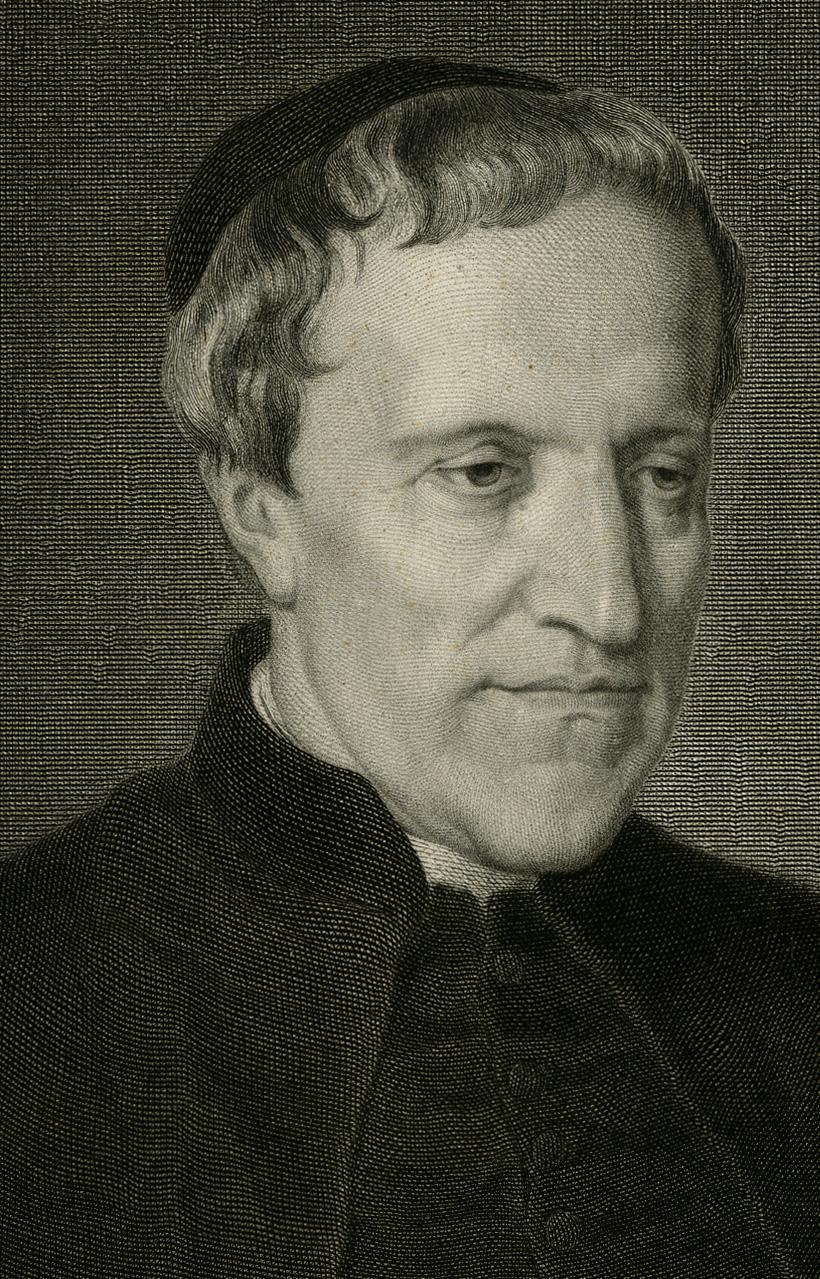
It is through the Italian philosopher and Catholic priest, Antonio Rosmini-Serbati (1797-1855) and his Rosminians, that Italy had an expression of theosophy through Rosmini’s systematic philosophical theology before the nineteenth-century modern Theosophical Movement1 . Rosmini’s system reflects Catholic theology, and not an esoteric system, and the incorporation of his philosophy and legacy was not immediate within the Church.
After Antonio Rosmini-Serbati’s death (July 1, 1855 in Stresa, Italy), a work of eight volumes was published initially under the title “TEOSOFIA.”
This is indicative of the program here as to the eighteenth-century Theosophists, French Illuminés and Spanish Alumbrados. Antonio Rosmini-Serbati and the Rosminians were condemned and opposed by the Society of Jesus (Jesuits) in that time.
Pope Leo XIII condemned forty of Rosmini’s propositions in 1887. In 1998, Pope John Paul II in the encyclical Fides et Ratio named Rosmini one of the greater Christian thinkers. Rosmini was beatified 18 November 2007 in Novara, Italy.
The authorization for benediction was decreed by Pope Benedict XVI 3 June 2007, and Rosmini was declared to be “Venerable.” Antonio Girardi and Edoardo Bratina, in their Theosophy in Italy contribution to the Theosophical Encyclopedia suggest, that the rapid growth of Theosophy in Italy is connected to the Rosminians. Helped by Alfredo Pioda, who established the first Theosophical Center in Switzerland, J. Murphy established the first Theosophical Center in Milan in 1890.
Alfredo Pioda began the magazine, La Nuova Parola. The first Lodge and library was established in Rome, 1897 by C.A. Lloyd and Decio Calvari, who was the secretary of the Italian Parliament. Lodges were established in Genoa and Palermo by British Consul Macbean Reginald Gambier. Isabel Cooper-Oakley later establishes lodges in Milan, Florence, Naples, Torino and Rome.
ROSMINI’S TEACHINGS AND ONTOLOGY: THEOLOGY ON ITS KNEES — Greetings and introduction BY Giuseppe Betori, Archbishop of Florence
FOOTNOTES
- Helena P. Blavatsky (Russian Theosophist and Buddhist, co-founder of the Theosophical Society) frequently visited Italy in namely Bologna, Bari, Trieste, Venice, Rome, and Naples. Many of her acquaintances in Italy became members of the Theosophical Society. In 1851, Blavatsky met Giuseppe Mazzini, and at the “Battle of Mentana” (Rome) in 1867 she participated with volunteers alongside the troops of Giuseppe Garibaldi. ↩︎