“Many circumstances at present loudly call upon us to exert ourselves. Venality and corruption have well-nigh extinguished all principles of Liberty (…) One remedy for these evils is to revive the reading of our old Writers, of which we have good store, and the study whereof would fortify our youth against the blandishments of pleasure and the arts of Corruption.”
Thomas Hollis (1720-1774), in The Works of John Milton, p. iv., quoted in Rachel Hammersby, Republicanism: An Introduction (2025), p. 97.
One central consistent call throughout the centuries and ages in the republican tradition is a call to return to the wisdom of the older writers as guidance. Thomas Hollis felt it his utmost duty.
This civic habit is at the center of the tradition. The older republican call, from Machiavelli’s return to first principles through Milton, Sidney, Locke, and Thomas Hollis’s reprints was a civic habit in using earlier writers on mixed government, resistance to tyranny, and public virtue when present institutions grow corrupt. That habit predates modern racial science and the mature Atlantic slave order as a racial caste system. Treating reverence for those texts as coded “whiteness” or proto-fascism collapses different things: a tradition about politeia (how a free state is ordered) with later fascist romanità, Nazi Hellenism, and nineteenth-century racial talk about “the West.” Fascists did raid antiquity, but that does not make Livy or Hollis their property, any more than it makes every defense of old books a racial program.
What is real is a postwar and campus habit of association: organic community, classics, and ancestor-regard get read as a slope toward hierarchy or the Third Reich, so love of the foundations is shamed in advance. That pressure is sloppy history and does function as moral blackmail. It is not “the left” as a single doctrine, and the right sometimes does the mirror move by claiming marble and Rome as an ethnic inheritance. The accurate split is which antiquity you want: mixed constitution and accountable power, or blood, rebirth, and the re-adapted fasces. Shame does not settle that question; but reading the books does. From Machiavelli’s Discourses on Livy onward, republicans treat decay as the ordinary fate of free states and treat a return to older writers, and to the principii those writers recorded as the standing remedy. Machiavelli’s formulation in Book III, chapter 1 is the classic one: if a sect or a republic is to last, it must often be drawn back toward its beginning. Later English and American writers treated Livy, Sallust, Cicero, Polybius, and then their own seventeenth-century successors as the archive of that beginning.
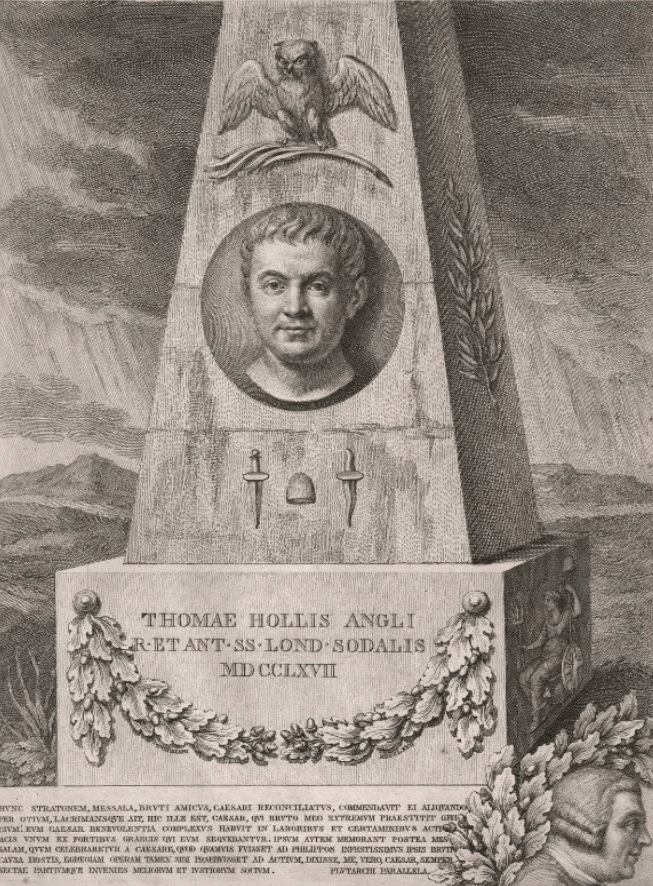
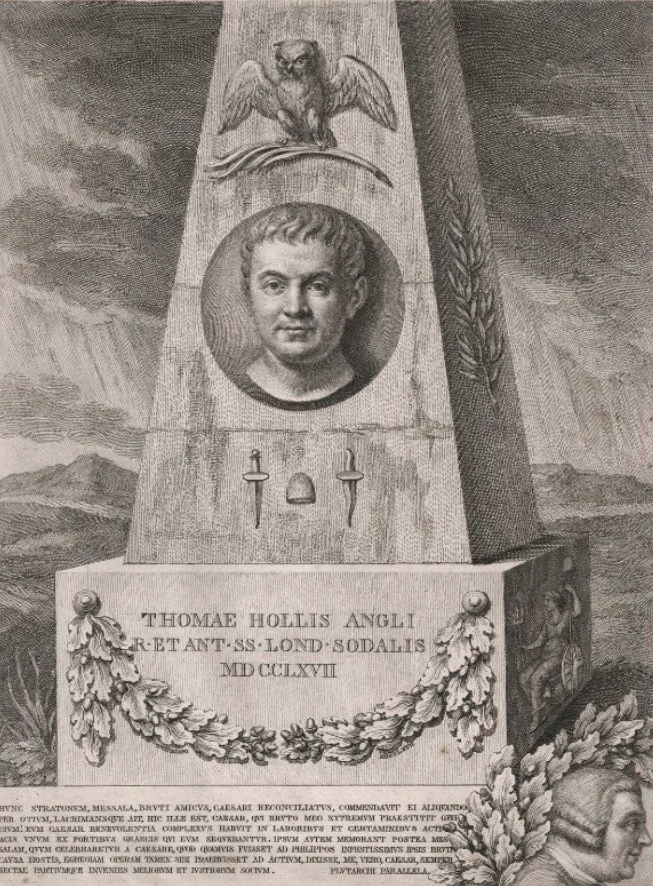
Thomas Hollis (1720-1774) made the transmission of that archive his life’s work. He was an independently wealthy Real Whig, or “eighteenth-century Commonwealthman,” who declined a parliamentary career and instead financed, edited, bound, inscribed, and mailed a “sacred canon” of liberty texts. The core authors were John Milton, Algernon Sidney, John Locke, James Harrington, Henry Neville, Marchamont Nedham, John Toland, Robert Molesworth, and François Hotman. Rachel Hammersley makes note of this in her book, Republicanism: An Introduction (pp. 96-99). He commissioned handsome new editions from Andrew Millar, had them tooled with the Phrygian cap, the owl of Minerva, Britannia, and Brutus’s dagger, and sent them often anonymously, with the motto “ut spargam” to Harvard, other American colleges, British and continental libraries, and individual correspondents such as Jonathan Mayhew.
Perhaps, we should do the same . . . .
His memorialist Francis Blackburne later summarized the purpose in words. Hollis aimed “to stem the pernicious current and apprise the men of England of their danger, by referring them to those immortal geniuses Milton, Sidney, Locke, &c. for instruction upon what only solid foundation the preservation of their rights and liberties depends.” Hollis himself called Milton “my hero, and the guide of my paths.” He bought Milton’s deathbed, named a farm after him, and treated the prose works — Areopagitica, The Tenure of Kings and Magistrates, the Defences — as living counsel rather than historical curiosities.
Two nuances matter. First, Hollis was not calling for the abolition of the British monarchy in the 1760s. He inscribed many of the volumes he sent to Harvard as coming from “a Lover of Liberty, his Country & its excellent Constitution as NOBLY restored at the happy Revolution.” The older writers were to be used to defend the 1688 settlement and the right of resistance against what he saw as a new tide of corruption and prerogative under George III, not to repeat 1649. Second, he sometimes sent opposing texts as well (Clarendon beside Milton, Filmer beside Locke) on the ground that liberty could not be understood without its opposite.
The practical effect was considerable. John Adams encountered the Hollis canon as a Harvard student. Thomas Jefferson and other colonists read the same specially bound volumes. Caroline Robbins, Bernard Bailyn, and later scholars have treated Hollis’s private “Plan” as one of the conduits that carried seventeenth-century English republicanism into the American founding. In that sense he did exactly what the tradition had always prescribed: he treated the older writers not as antiquarian ornaments but as the only reliable guide when present institutions began to forget themselves.