This is about my reflections during and after visiting the Museum of Hydra (Idra) island in Greece. It explains anti-Masonic myths about the American Revolution, the counter-Enlightenment reading of 1776, the history of Enlightenment Lodges, Republican Revolutions, and the habit of political paranoia in the United States — as opposed to the memory of the Greek War of Independence, Freemasonry, and the cause of the Filiki Eteria inspired by the French Revolution and Italian Carbonari. This answers why Hydra kept the revolutionary inheritance that America recoded as conspiracy.
𓆝 𓆟 𓆞


Back in August, my wife and I visited Greece, and we chose Hydra (Idra or Ýdra) as our mainstay ending our weeklong trip in Athens. We visited the Historical Archives Museum of Hydra August 20 (2025), which is administered by the Ministry of Education and Religious Affairs through the General State Archives. This meant that the island’s historical collections and documentary holdings are managed as part of Greece’s national archival system rather than as an independent municipal museum. Hydra is a small, car-free island in the Saronic Gulf, which appealed to us more than Santorini. The gorgeous island retains a vivid, locally celebrated memory of its outsized role in the Greek War of Independence of 1821, and the museum features a slew of historical objects, weapons and historical points of reference and republican symbolism in paintings. We learned about its history of wealthy ship-owning families and seamen supplying roughly 120-150 vessels, thousands of sailors, and substantial funds, transforming merchant ships into a decisive naval force that, alongside Spetses and Psara, contested Ottoman control of the Aegean.


The uprising was proclaimed on the island itself on the night of 27 March 1821 by Captain Antonios Oikonomou, a member of the Filiki Eteria (Society of Friends), the secret revolutionary organization founded in Odessa in 1814.
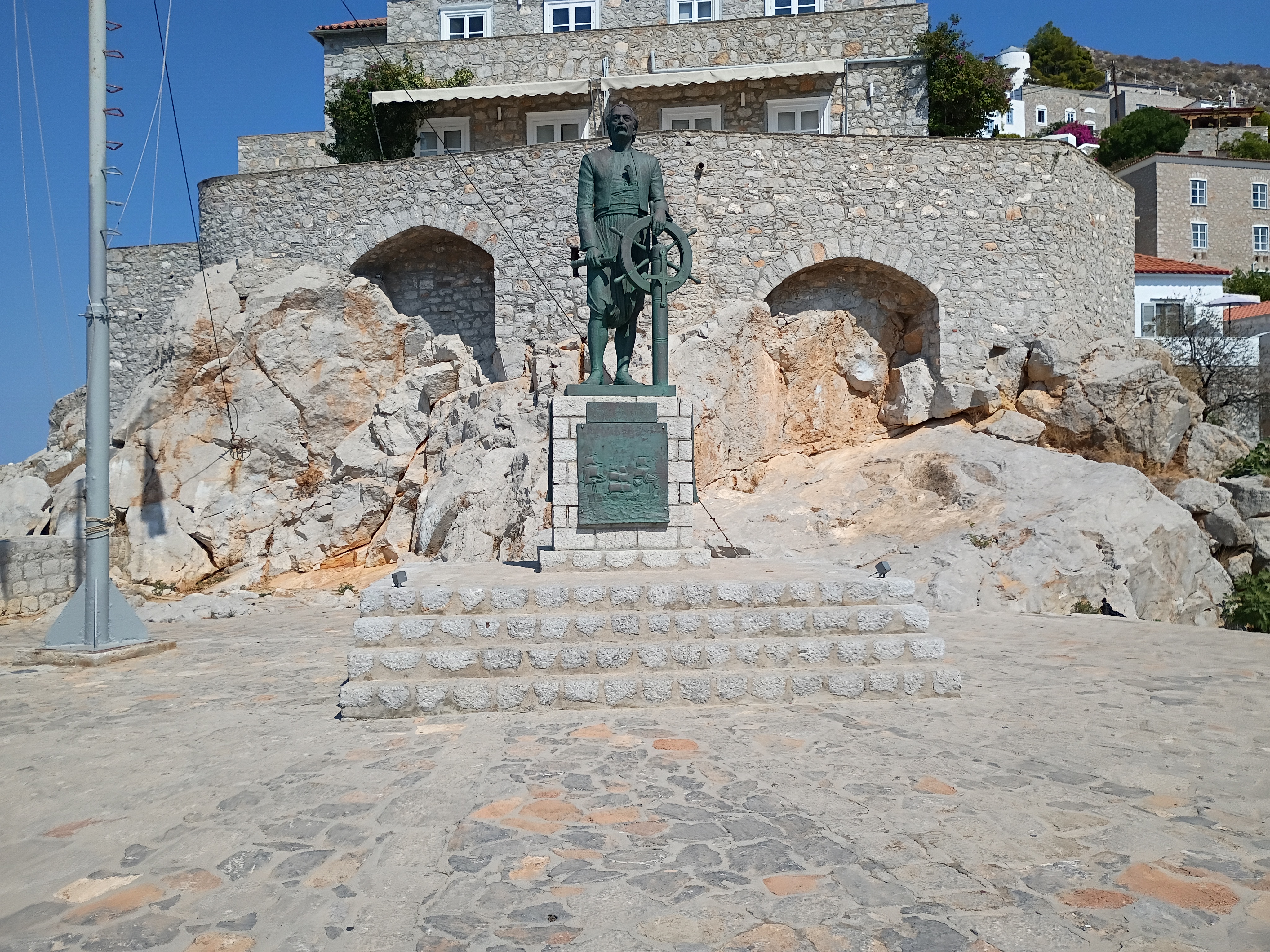
Key Hydriot figures such as Admiral Andreas Miaoulis (whose fire-ships devastated Ottoman fleets), Lazaros Kountouriotis (who donated his fortune), and others became national heroes. Local pride seemed clearly institutionalized with the annual Miaoulia festival re-enacting naval victories with fireworks and sea battles; captains’ mansions functioning as museums (notably the Lazaros Kountouriotis mansion, a branch of the National Historical Museum); statues of Miaoulis stand at the harbor; and the island’s wartime flag bore the Spartan maxim “ἢ τὰν ἢ ἐπὶ τᾶς” (“with it or on it” — victory or death). Later Hydriot descendants, including Pavlos Kountouriotis, even served as president of the interwar Greek Republic, connecting the island’s revolutionary past to subsequent republican moments.
The Filiki Eteria that catalyzed the revolt was explicitly modeled on Freemasonic and Carbonari structures: hierarchical degrees, oaths of secrecy, initiation rituals, and a rhetoric of fraternal enlightenment against tyranny. Several founders and early members had direct Masonic ties, and the society’s network of merchants, intellectuals, and officers spread Enlightenment-derived ideas of popular sovereignty, constitutional government, and civic virtue. Early revolutionary assemblies produced constitutions (Epidaurus 1822, Astros 1823) that established legislative and executive bodies without a king, reflecting those ideals before the Great Powers imposed a Bavarian monarchy in 1832.
On Hydra, this history was not subterranean or embarrassing to its inhabitants; but is public, familial, and proud, preserved in placenames, festivals, and museum displays as the island’s defining contribution to national liberation.
This continuous local veneration contrasts sharply with the relative erasure of classical republicanism and the persistent conspiratorial suspicion of Freemasonry in the United States. CLASSICAL REPUBLICANISM was a central intellectual framework for the American Founders, drawn from Polybius, Machiavelli, Harrington, and the English Commonwealth tradition. Yet it has largely receded from popular education and civic memory, displaced by a simplified Lockean liberal narrative focused on individual rights, markets, and democratic majoritarianism. Historiographical shifts, the decline of classical schooling, and the practical evolution of a commercial republic made the older vocabulary of “virtue” and “corruption” feel archaic, demanding or academic rather than living.
Freemasonry, which counted many Founders among its members and shared the same Enlightenment milieu of fraternal self-improvement and anti-despotic ideals that influenced the Filiki Eteria, suffered a different fate. Secrecy of oaths and rituals collided with Protestant evangelical distrust of closed societies and with Jacksonian-era populism. The 1826 Morgan Affair, involving the alleged murder of a man who threatened to expose Masonic secrets, ignited a nationwide anti-Masonic movement that produced America’s first third party, elected governors, and framed lodges as elitist, anti-Christian, or conspiratorial. That suspicion never fully dissipated, and metastasized into enduring theories of Illuminati infiltration, “New World Order” control, and occult cabals. In short, the same Enlightenment organizational forms that Greeks could celebrate as patriotic instruments of national rebirth became, in the American context, objects of democratic anxiety about hidden power.

Hydra’s scale is intimate with a few thousand inhabitants whose family names, mansions, and festivals still map directly onto 1821. Greek national identity was forged in the struggle against Ottoman rule, so secret societies that organized liberation are absorbed into the heroic national story rather than treated as alien. The United States is by contrast a large, plural society whose founding mythology emphasizes open constitutionalism and popular transparency, but this is no excuse to maintain an opposite treatment of its Freemasonic roots. Secrecy itself became suspect through campaigns and deliberate instigations. Classical republicanism’s demanding ethic of virtue proved harder to sustain than rights-based liberalism, but this is not the fault of the republican philosophy, but of the people itself incapable of sustaining it.
Where Hydra displayed its revolutionary and proto-republican heritage without embarrassment, American public culture has tended to privatize or pathologize the fraternal and classical strands of its own revolutionary inheritance.
The lasting cultural divergence that I recognized between my own home country and Hydra was that while Hydra and broader Greek national memory treat their revolutionary, proto-republican, and Filiki Eteria and its Masonic-linked heritage as a source of open local and national pride, American public culture has largely privatized classical republican ideas and pathologized the fraternal (especially Masonic) strand of its own founding tradition. The consequences of that American pattern have been both structural and cultural, unfolding over nearly two centuries.
First, the relative eclipse of classical republicanism in popular understanding and civic education left Americans with a thinner shared political vocabulary. Classical republicanism supplied the Founders with a language of public virtue, corruption as the decay of character and institutions, mixed government, and the common good as something more than the sum of private interests. Once that framework receded — supplanted in textbooks, political rhetoric, and everyday discourse by a predominantly Lockean emphasis on individual rights, consent, and commercial self-interest — public life lost ready tools for diagnosing systemic problems that are not purely legal or economic. Corruption became harder to name except as scandal or illegality; civic virtue risked sounding moralistic or elitist; and appeals to the common good often collapsed into interest-group bargaining or identity claims.
Scholars such as the late historian of republicanism Gordon S. Wood (1933-2026) who passed earlier this year before the 250ᵗʰ anniversary have described this shift as the “end of classical politics,” enabling a more dynamic, interest-driven commercial republic while simultaneously making sustained deliberation about character, scale, and the long-term health of institutions more difficult.
Second, the pathologization of Freemasonry and similar voluntary fraternal forms produced a durable conspiracy tradition. The Anti-Masonic movement of the 1820s-1830s, sparked by the Morgan Affair, was the first significant third party in American history. It pioneered nominating conventions, party platforms, and mass mobilization against perceived secret elites. That episode normalized the suspicion that private oaths, hierarchical lodges, and elite networks are inherently anti-democratic or anti-Christian. Over time this suspicion migrated into broader cultural forms: popular interpretations of Masonic symbols on the dollar bill or in architecture as evidence of hidden control, recurring “Illuminati” narratives, and modern variants of “deep state” or New World Order theorizing has consumed popular political American imagination. The practical result has been a persistent low-level distrust of any institution that is not fully transparent, which can serve as a democratic check but more often fuels alienation, populist over-simplification, and the displacement of concrete institutional critique by occult explanations.
Taken together, these developments have contributed to a distinctive American pattern: a strong rights-based liberalism and commercial dynamism paired with recurrent difficulty sustaining a robust, non-conspiratorial language of civic membership and elite responsibility. Classical republicanism’s demanding ethic of virtue was never easy to maintain at continental scale; and privatizing it and treating fraternal organization with suspicion made the republican experiment more inclusive and less hierarchical in some respects, yet also more prone to cycles of institutional distrust and thinner shared civic identity. In contrast to a place like Hydra, where revolutionary secrecy and republican aspiration could be publicly memorialized as heroic, the American tendency has been to keep those strands either academic, folkloric, or shadowed by suspicion, leaving the public square richer in rights-talk and poorer in the older republican grammar of character, corruption, and common purpose.
The trip to the museum left me with a very sad and sour feeling, because of the dominance of political paranoia and conspiratorial narrative that seeps into ordinary citizen’s view of the American Revolution, which comes from the counter-Enlightenment imported narratives in the eighteenth-century and builds upon an Anti-Masonic history. I visited the gift and book shop where books on Masonic Wisdom sat side-by-side with ones on Christian Wisdom, Presocratic philosophy and the Seven Sages of Greece. I was jealous and mad with my country. The problem with Americans is the fact that a solid defense against this narrative does not reach nearly half as much as those who would tune into someone vomiting pseudo-history to them — revealing that Americans do not seem to care or are serious about our political legacy and its history if it does not involve a deconstructed negative critique of it or praise it in reactionary tone to the habit of the former.
Let me explain more to put in perspective the consequences of not getting this history right. In my writings, I have brought attention to the counter-Enlightenment reading of the American Revolution, which advances the view that it was less a republican experiment in self-government than the first successful operation of a Masonic-Illuminati cabal against throne, altar, and organic hierarchy, which was all an imported narrative. It was first packaged in Abbé Barruel’s Mémoires pour servir à l’histoire du jacobinisme (1797-98) and John Robison’s Proofs of a Conspiracy (1798), then naturalized by New England Federalist clergy during the Illuminati scare of 1798 and later industrialized by the Anti-Masonic Party after the 1826 Morgan Affair. That reading treats lodges as occult command-and-control nodes rather than what they actually were: one among several overlapping forms of Enlightenment sociability among print networks, merchant credit circles, corresponding societies, and military brotherhoods, through which men who already shared Lockean, classical-republican, and commercial-cosmopolitan premises coordinated under conditions of legal risk.
The Hydriot case, far from being an exotic contrast, is the same circuit operating under Ottoman rather than British constraints. To treat the two as opposites is to accept the counter-Enlightenment’s own premise, that any organized challenge to dynastic or theocratic authority must be a secret plot rather than an open (if discreet) application of reason to politics.
Speculative Freemasonry after 1717 was not a hidden government. Anderson’s Constitutions (1723) codified a civic religion of “that Religion in which all Men agree,” explicit religious latitudinarianism, and the fiction of operative origins that allowed gentlemen, merchants, and artisans to meet as equals inside a ritual frame. In the colonies this proved useful precisely because it was not a political party. Of the 56 Declaration signers, nine were documented Masons; of the 39 Constitution signers, thirteen. Washington, Franklin, Revere, Warren, Hancock, and Marshall were members; and Adams, Jefferson, Hamilton, and Madison were not. Military lodges traveled with the Continental Army; and “Ancient” lodges (the more artisan, more Patriot-leaning bodies that broke from the “Moderns”) supplied officers and intelligence. None of this required a Grand Orient directing events from London or Paris. It required only that men already committed to resistance against parliamentary taxation and standing armies possessed a pre-existing, portable, oath-bound network that could function when committees of correspondence were watched and when the official church was the Church of England. The same men disagreed violently over banks, slavery, and the Constitution. Masonry supplied sociability and mutual recognition, not a platform.
The later American anti-Masonic tradition inverted this. After 1798 the Federalist clergy (Jedidiah Morse, Timothy Dwight) imported Barruel-Robison to explain Jeffersonian success as Illuminati infiltration of American lodges, Jefferson refuted this attack very well. In this attack, he also quelled the conspiracy by identifying the foundations of Weishaupt’s “Perfectibilist” ideal in the philosophy of the utopian anarchist William Godwin (1756-1836), thereby situating Weishaupt in historical context as a philosopher of the Enlightenment. After 1826 the Anti-Masonic Party (the first third party) converted a local kidnapping-and-probable-murder into a national crusade against secrecy itself, against “preference,” against any association that claimed moral authority outside evangelical conscience and public opinion. The party’s literature recycled the same charges Barruel had leveled at the French: that oaths superseded civic loyalty, that higher degrees hid atheism, that the order was a foreign engine for leveling. That literature then leaked backward onto 1776, so that Washington laying the Capitol cornerstone in Masonic apron in 1793 is read as a confession rather than as the public performance of a civic cult that the early republic itself had embraced. The paranoia is not an analysis of the Revolution. It is a post-Revolutionary evangelical and populist reaction against the very Enlightenment sociability that had made the Revolution possible, and it is an incorrect one.
The Greek parallel is tighter, not looser. The Ionian Islands under Venetian, then French, then British rule were the only part of the Greek world where lodges could operate with relative safety. Beneficenza (Corfu, 1782), revived under French occupation, Phoenix (Corfu, 1818), Enosis/L’Union (Lefkada), and the Serene Grand Orient of Greece organized by Dionysios Romas in 1811 to 1816 formed a corridor. Emmanuel Xanthos, a Patmos merchant, was initiated in the French lodge L’Union at Lefkada in 1813. His own memoirs state that the lodge experience supplied the model: secrecy, graded initiation, oaths, an “Invisible Authority,” and the conviction that a similar structure could organize Greeks for liberation. In September 1814 in Odessa he, Nikolaos Skoufas, and Athanasios Tsakalov founded the Filiki Eteria “in freemasonic fashion.” The Eteria’s four grades (Brother, Recommended, Priest, Shepherd), its temples, its coded correspondence, and its claim to transmit orders from an unseen center are direct adaptations.
Recruitment lists show the network reaching Hydra: Anagnostaras (Anagnostopoulos) was sent there; and Hydriot names appear among initiates. The island’s great shipowning families I mentioned earlier were Koundouriotis, Miaoulis (Vokos), and Tombazis. These families were not required to sit in lodge to be inside the same commercial-republican circuit. Hydra’s fleet, built on Napoleonic-era grain and blockade-running profits, was the largest in the eastern Mediterranean. When the Eteria’s timetable collapsed and the Peloponnese rose in March 1821, Hydra committed its ships. Without that fleet the revolution dies at sea. The same merchant cosmopolitanism that produced Franklin’s Philadelphia lodge produced Hydra’s captains.
Hydra itself was not a Masonic island in the Corfiote sense. It was an Arvanite (Tosk Albanian-speaking) granite rock whose population had arrived as refugees, whose wealth was liquid and maritime, and whose political culture was already a miniature merchant republic: assemblies of captains and owners, profit-sharing with crews, flags of convenience (Russian, Ottoman, Ionian). That culture needed no German Illuminati to teach it that distant imperial centers could be evaded and that armed association among equals was possible. The Eteria supplied the coordinating membrane that linked Hydriot capital to Moreot klephts, Phanariot diplomats, and Ionian lodges. European Masonic networks then supplied the philhellene pipeline: money, volunteers, and publicity from Geneva, Paris, London, and the German states. The “conspiracy” was the ordinary conspiracy of subject peoples who cannot publish a manifesto in the capital of the empire that rules them.
The counter-Enlightenment narrative must flatten all of this into a single occult plot because it cannot concede that Enlightenment forms of voluntary association, printed publicity, commercial credit, and ritualized equality among men of different confessions were effective against old-regime monopolies of violence and legitimacy. Barruel and Robison needed the lodges to be the hidden authors of 1789 so that the Revolution could be denied the status of a political event and reclassified as a crime. American Anti-Masons needed the same move so that the Founders’ own sociability could be recoded as proto-Jacobinism.
But what I learned from the Museum of Hydra is that the Hydriot record is inconvenient for that move. The islanders’ contribution was ships, powder, and cash, not ciphers and pentagrams. Their “Masonic ties” were the same ties that ran from Boston’s Green Dragon Tavern to Cádiz’s Lautaro lodges to Odessa’s Greek square: merchant and officer networks that had already decided that legitimate authority derives from the governed, not from anointed succession.
What the paranoid reading cannot explain is why the same organizational technology produced Washington and Miaoulis rather than a uniform world government. Lodges contained Tories and Patriots, royalists and Carbonari, Orthodox bishops and Deist merchants. The variable was not the ritual; it was the political situation into which the ritual was inserted. Under a parliamentary empire that still allowed colonial assemblies and a free press, the lodge was a supplement. Under the Ottoman millet system and the Holy Alliance’s restoration police, the lodge-plus-Eteria was a necessity. The counter-Enlightenment prefers the occult explanation because the political explanation that large numbers of commercially connected, lettered men across the Atlantic and Mediterranean simply stopped accepting that their lives should be administered by courts they did not elect is more threatening. It implies that the “conspiracy” was the Enlightenment itself, operating in public as well as in lodge, and that the Hydriots and the Patriots were its competent local agents rather than its dupes.
The Hydriots maintain their pride, and it is no excuse to us, because they are small and local. The Hydriot and Patriot worlds belonged to an Atlantic age in which merchant islands, port cities, and officer networks could still imagine themselves as the measure of a republic. The United States outgrew that scale. It became a mass democracy, an industrial power, then a global one. Scale changes memory, but this is no excuse. My country inherited a larger, more unstable version of the same thing. The American Revolution was not only a war of independence, but the moment when Enlightenment sociability helped turn colonial elites and artisans into a republic. That inheritance was contested almost immediately.
By the late 1790s the Illuminati scare had already recoded those networks as contamination. By the 1820s Anti-Masonry turned secrecy itself into a civic crime. Anti-Masonry was never only elite panic. After the Morgan Affair, it was also a popular moral language: evangelical, anti-aristocratic, hostile to “preference.” It said secrecy was incompatible with democracy. That charge is not empty. Secret preference can rot a republic. The error is treating one fraternity’s rituals as the master key to 1776, 1789, or 1821, and then repeating Barruel and Robison as if they were footnotes one discovered alone. Mass inversion works by making a borrowed plot feel like a personal insight. The more widely the myth is shared, the more each retelling can advertise itself as daring. The country therefore received two traditions at once: the revolutionary one that treated association, reason, and self-government as adult tools, and a counter-tradition that treated those same tools as proof that the founding had been a plot. The second tradition never left. It just changed costumes. My country does not carry the pride, really, of the underlying cause of the republican revolution in general, nor in federalist or national context. State to state the fire is dying, and my country is a country out of time, and unable to mature and carry this inheritance.
Maturity means carrying the contradiction instead of resolving it into either shrine or exposé: that lodges and committees were instruments of liberty and clubs of preference; that Washington in an apron at the Capitol was civic theater, not a confession; that Hydra’s captains were patriots and profiteers of a wartime sea. A mature republic would neither need the Founders to be saints nor need them to be Illuminati. It would treat 1776 the way a grown Hydriot can treat 1821 as a usable past that does not have to be occult in order to be real.
Paranoia and piety are both ways of refusing adulthood. One says the inheritance is poisoned. The other says it is too sacred to examine. Both leave the actual political craft of the revolutionary generation, with association under risk, coordination without a king, and public argument backed by private trust, unpracticed. Hydra can still point to its ships. The United States can only point to documents and monuments, which are easier to spiritualize or to denounce. The habit of forming bodies that are neither church nor state and then using them to make a people capable of ruling itself is our political inheritance, but the history is stupidly demonized. The masses often seem aware that in spreading these old myths and narratives, that they are happily engaging in free suspicions well within their individual rights, except they are actually engaged in popular mass inversion. Whether a country can carry that habit has less to do with blood or soil than with whether it still believes that such bodies are legitimate. Hydra, for its own reasons, still does. But my country keeps asking whether they were a trick. That question is itself immature.


RECOMMENDED SOURCES FOR FURTHER READING
- James Anderson, The Constitutions of the Free-Masons, Containing the History, Charges, Regulations, &c. of that Most Ancient and Right Worshipful Fraternity, London, 1723.
- Augustin Barruel, Memoirs Illustrating the History of Jacobinism, Translated by Robert Clifford, London, 1797-1798.
- Roderick Beaton and Niels Gaul, eds., The Greek Revolution of 1821: European Contexts, Scottish Connections, Edinburgh University Press, Edinburgh, 2024.
- Steven C. Bullock, Revolutionary Brotherhood: Freemasonry and the Transformation of the American Social Order, 1730-1840, University of North Carolina Press, Chapel Hill, 1996.
- Julia Chatzipanagioti-Sangmeister, The Philiki Etaireia and Freemasonry: Secret Communication, the Public Sphere and Social Ideas, in Roderick Beaton and Niels Gaul, eds., The Greek Revolution of 1821: European Contexts, Scottish Connections, Edinburgh University Press, Edinburgh, 2024.
- Julia Chatzipanagioti-Sangmeister, Η Φιλική Εταιρεία και ο τεκτονισμός: μυστική επικοινωνία, αστική δημοσιότητα και κοινωνικές ιδέες, Μεσαιωνικά και Νέα Ελληνικά 14, 2021.
- David Brion Davis, Some Themes of Counter-Subversion: An Analysis of Anti-Masonic, Anti-Catholic, and Anti-Mormon Literature, Mississippi Valley Historical Review 47, 1960.
- Jonathan Israel, The Expanding Blaze: How the American Revolution Ignited the World, 1775-1848, Princeton University Press, Princeton, 2017.
- Peter Linebaugh and Marcus Rediker, The Many-Headed Hydra: Sailors, Slaves, Commoners, and the Hidden History of the Revolutionary Atlantic, Beacon Press, Boston, 2000.
- Andreas C. Rizopoulos, European Freemasons and the Greek War of Independence, Heredom 13, 2005.
- Andreas C. Rizopoulos, Activités maçonniques avec arrière-plan politique – et réciproquement – en Grèce au XIXe siècle, Cahiers de la Méditerranée 72, 2006. French and English version.
- John Robison, Proofs of a Conspiracy Against All the Religions and Governments of Europe, Carried on in the Secret Meetings of Free Masons, Illuminati, and Reading Societies, Edinburgh, 1797.
- Mark Schmeller, How America’s First Third Party Influenced Politics, HISTORY, 2022.