
the Founding of a City and its Character
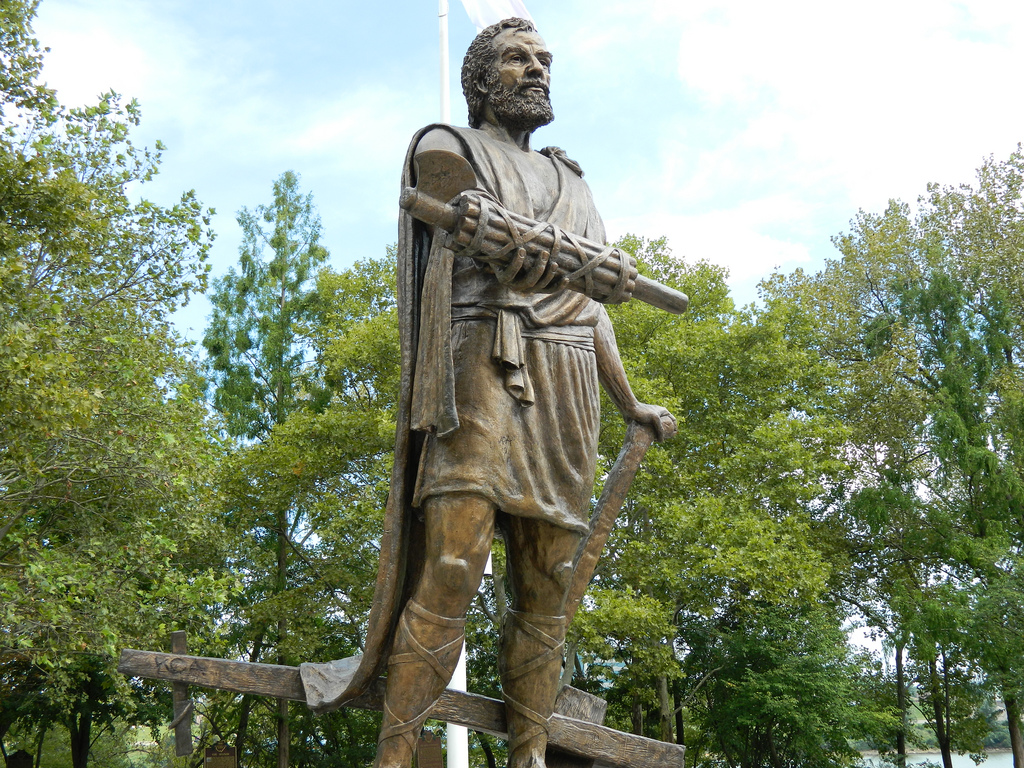
Lucius Quinctius Cincinnatus, the legendary Roman who defeated the Aequians and rescued the trapped Roan Army. With one hand he returns the fasces, symbol of power and fraternity to the Dictator of Rome. In the other, a plow, which represents his life as citizen and farmer. Cincinnati was named in 1790, after Cincinnatus by Governor Arthur St. Clair, member of the Society of Cincinnati, an order of Revolutionary War Officers whose first President was George Washington, who himself in his day was likened to Cincinnatus.
To see why Cincinnatus is shown with the fasces is to see an emblem that never meant only power. In Roman hands it was both the magistrate’s right to coerce and the citizen’s reminder that coercion had limits: axes stripped inside the city, bundles lowered before the people, lictors who could clear a street and also be broken of their rods. That double life did not begin in the Republic. Rome took the fasces from the Etruscans, an origin the Vetulonia burial makes hard to doubt, and then rewrote the rules so the same object could threaten and restrain. Behind that Etruscan symbol lies a thinner, older thread: the double axe of the Aegean, the Minoan labrys, a sacred and royal sign whose later career in Anatolia and Italy may have fed the axe inside the bundle. The fasces is not a Cretan invention. It is a Roman argument conducted with an Etruscan instrument, and that instrument may still carry an Aegean edge.
Aegean origins and history of the fasces: from Minoan Crete to republican symbol continues a study of this symbol.
The earliest object that is unmistakably a fasces is not Cretan. In 1897 Isidoro Falchi opened a mid-seventh-century BCE tomb at Vetulonia, in Etruria, and found a miniature iron bundle with a double-headed axe, or the so-called Tomb of the Lictor, now dated about 630-625 BCE. Roman writers already said the kings had taken lictors and fasces from the Etruscans; the iron model confirmed the direction of the borrowing. Silius Italicus even named Vetulonia. Twelve lictors before a king, each with the bundle, marked imperium: the right to beat with the rods and, when the axe was present, to kill.
What Crete contributes is the axe, not the bundle. The Minoan labrys (the double axe) is one of the most persistent signs of Bronze Age Crete, from Early Minoan votives and pendants through palatial mason’s marks, seals, and frescoes at Knossos and Phaistos. It is ritual more than judicial: set between horns of consecration, carried in ceremonial contexts, tied to cult rather than to a lictor’s shoulder. Later the same form appears with Zeus Labraundos in Caria. Some modern accounts suggest that Etruscan fasces symbolism, especially the double axe in early examples, may have traveled west from this eastern Mediterranean repertoire. The evidence for that path is thin. No Minoan bundle of rods has been shown to be the ancestor of the Roman fascis, and the Latin word itself goes back to an Indo-European root for “band” or “bundle,” not to a Cretan term.
Rome’s innovation was political, not iconographic. Tradition dates the Republic to 509 BCE and credits the new order with a deliberate softening of the regal kit. Consuls alternated the full twelve fasces rather than splitting them. Inside the pomerium the axes came out, except for a dictator or a triumphing general, because a citizen could appeal (provocatio) a capital sentence. Lictors lowered the bundles before the assembly and before a higher magistrate, with the gesture later proverbial as submittere fasces. A dictator, called in crisis, received twenty-four, the consular pair doubled, which is why the plowman-dictator Cincinnatus is pictured with them: temporary, total authority, visibly returned. After the Valerian protections hardened, the rods and axe became more emblem than immediate tool, but the threat remained legible. A single rod breaks; yet the bundle does not. That secondary moral of strength through unity is Aesopic as much as Roman, and it is the reading later centuries preferred.
The republican fasces is therefore three things at once. It is an Etruscan instrument of terror, adopted and then partly disarmed. It is a civic argument about who may punish, and where. And it is, at the axe alone, a possible heir of an Aegean sign whose original meaning was sacred display, not summary justice. Cincinnatus bears it because the Republic wanted both the memory of unchecked power and the proof that power could be laid down.