THE DUAL NATURE OF ZEUS, PROMETHEUS AS CULTURE-HERO, THE ANTI-TYRANNICAL FOUNDATIONS OF REPUBLICAN THOUGHT, AND THE SUPPRESSION OF HEBRAIC REPUBLICANISM IN CHRISTIAN TRADITION
“These fairy tales are not senseless stories written for the amusement of the idle; they embody the profound religion of our forefathers.” (W.S.W. Anson, Asgard and the Gods: Tales and Traditions of our Northern Ancestors)
“For a myth, in Greek mythos, means oral tradition, passed from mouth to mouth from one generation to the other; and even in the modern etymology the term stands for a fabulous statement conveying some important truth; a tale of some extraordinary personage whose biography has become overgrown, owing to the veneration of successive generations, with rich popular fancy, but which is no wholesale fable.” (Helena P. Blavatsky, The Secret Doctrine, Vol. 1, p. 425)
- INTRODUCTION
- ZEUS IN HOMER AND HESIOD: SON OF KRONOS, LORD OF MEN
- ORPHIC THEOLOGY: ZEUS AS DEMIURGE AND ALL-PERVADING ELEMENT
- THE DUAL NATURE: ABSTRACT DEITY AND OLYMPIC TYRANT
- CONGRUITIES AND CONTRADICTIONS IN THE CLASSICAL RECORD
- THE THEOSOPHICAL INTERPRETATION OF THE CLASSICAL TEXTS
- PROMETHEUS AND THE REPUBLICAN REFUSAL OF ABSOLUTE AUTHORITY
- SUPPRESSED HELLENISTIC JEWISH INFLUENCE ON CHRISTIAN REPUBLICAN THINKERS
- CONCLUSION
- REFERENCE SOURCES
- FOOTNOTES
- APPENDIX

INTRODUCTION
The classical republican tradition and the practices of Athenian democracy arise from the same Hellenic soil that produced the Homeric, Hesiodic, and Orphic portraits of Zeús, and the apparent distance between political philosophy and theogony is therefore only superficial. Republican liberty, understood as non-domination and the institutional containment of arbitrary power, finds its earliest mythic analogue in the consistent refusal of the Greek sources to identify the Olympian sovereign with an ungenerated First Principle. Just as the mixed constitution and the rule of law prevent any single will from becoming absolute, so creator gods, Chaos, Nýx (the manifest, visible darkness), and the Unknown Darkness (the ineffable, pre-cosmic obscurity) stand prior to Zeús, limiting even the lord of gods and men.
Athenian democracy’s perpetual contestation of tyranny, its ostracism of would-be despots, and its elevation of civic speech over hereditary claim mirrors the Promethean drama in which the civilizing Titan is punished by the same power that benefits from the ordered cosmos he helped to shape. The dual nature of Zeús as both demiurgic intelligence and jealous tyrant, already latent in the earliest texts and sharpened by the Orphic and Neoplatonic commentators, thus supplies the theological grammar for the political distinction between ordered authority and domination that later republicans from Polybius to Machiavelli would articulate in institutional terms. When it has been insisted by philosophical revivalists in the past couple centuries challenging theologians, that the immediate artificer is never identical with the absolute origin, this restates, in cosmological language, the founding insight of civic republicanism: that no power, divine or human, may claim to stand outside the hierarchy of principles that alone preserves freedom.
ZEUS IN HOMER AND HESIOD: SON OF KRONOS, LORD OF MEN
In the Homeric poems Zeús appears as the undisputed sovereign of gods and men. “Zeús, the son of almighty Krónos” (Iliad 2.350) and “Zeús, son of Krónos, is lord of all men” (Iliad 2.670) establish his dominion with blunt clarity. Yet the same tradition that elevates him also situates him within a genealogy that begins before him and points beyond him. The classical sources do not present a single, consistent portrait. They preserve a series of tensions: between Zeus as the highest visible ruler and a principle that precedes him; between the abstract cosmic force of Orphic theology and the passionate, anthropomorphic king of Olympus; between the demiurgic artisan of the ordered world and the jealous tyrant who chains Prometheus. These tensions are not later corruptions. They are already present in the earliest surviving texts and are sharpened, not invented, by the philosophical commentators of late antiquity.
ZEUS, lord of all men was conceived as many aspects, even as Soter (SAVIOR). Through Father ZEUS, chief of the protogenoi, humanity and all life is saved — those among his believers and the Orphics taught. Homer, Hesiod, the Orphic hymns and theogonies, Porphyry, Proclus, and Damascius all reveal very particular divergences in the Greek understanding of the highest powers.
Homer never elevates Zeús above the order of the Olympians in the absolute sense later claimed for an uncreated First Principle. Zeús is repeatedly identified by his parentage as son of Krónos. His authority is real and effective as “lord of all men,” yet it is an authority exercised within a cosmos that already exists and among powers that retain independent agency. Even the famous scales of Zeús in the Iliad measure destinies, for they do not create them from nothing.
Hesiod’s Theogony is more explicit about priority. “Verily at the first Kháos came to be, but next wide-bosomed Earth” (Theogony 116). Kháos1, Gaîa, Tártaros, and Érōs precede the entire Titanic and Olympian generations. Krónos is born of Ouranós and Gaîa; Zeús is born of Krónos and Rhéa. The succession myth itself is Ouranós overthrown by Krónos, and Krónos overthrown by Zeús presents each generation as both more ordered and more limited than the one before it. Zeús ends the cycle of successive dethronements by swallowing Mêtis (the titaness of wisdom, cunning, and deep thought) and giving birth to Athēnâ, thereby internalizing the principle of wise counsel. Yet the text never claims that Zeús is ungenerated or that he stands outside the chain of becoming.
ORPHIC THEOLOGY: ZEUS AS DEMIURGE AND ALL-PERVADING ELEMENT
The Orphic tradition preserves a more metaphysical idea. In the Orphic hymns Zeús is not merely the strongest of the Olympians but the all-encompassing power that contains the cosmos. One of the most frequently cited fragments declares:
“Zeús is first, Zeús is last, Zeús is the head, Zeús the middle of all things;
From Zeús were all things produced. He is male, he is female;
Zeús is the depth of the earth, the height of the starry heavens;
He is the breath of all things, the force of untamed fire…”(This longer version of the Orphic hymn is preserved in Eusebius, Praeparatio Evangelica 3.11.1, quoting Porphyry, On Cult Statues in Otto Kern’s Orphicorum Fragmenta, Fragment 168 (ed. Berlin: Weidmann, 1922)
“Zeus was the first, Zeus of the bright lightning is last;
Zeus is the head, Zeus the middle, with Zeus do all things conclude.
Zeus has a masculine nature, Zeus is an immutable bride…”
(This shorter version of the Orphic hymn is preserved in Eusebius, Praeparatio Evangelica 3.11.1, quoting Porphyry, On Cult Statues in Otto Kern’s Orphicorum Fragmenta, Fragment 167 (ed. Berlin: Weidmann, 1922)
Orpheus terms the power of Zeús “Aether, the high-reigning, ever indestructible power of Zeus” in the fifth hymn to Zeus (Orphic Hymn 5, To Zeus Εἰς Δία, line 6), which was used in rituals. Here Zeús is identified with the luminous, indestructible life-giving medium that pervades the universe, the “garment”2 of the highest deity rather than the highest deity itself.
Porphyry and Proclus, reading the Orphic material, present Zeus as the zôion ek zôíou (ζῷον ἐκ ζῴου), meaning a living being composed of living beings, the chief of the generative powers. In Orphic theology he represents both potentia and actus — the unrevealed cause and the active Demiurge who proceeds as an emanation from an invisible potency (Porphyry, On Cult Statues; Proclus, Theology of Plato). In this demiurgic capacity, joined to his consorts, Zeús gathers the agents of cosmic evolution into a single operative principle. Yet even here the philosophers insist on a distinction. Damascius, in On First Principles, records that the ancient theologians referred to the ultimate as “the Unknown Darkness.” Hesiod begins with Kháos, and Homer ascends no higher than Nýx (Night), whom Zeús himself is said to revere. The immediate artificer of the visible universe is therefore not identical with the highest principle (Damascius, On First Principles 123).
THE DUAL NATURE: ABSTRACT DEITY AND OLYMPIC TYRANT
Classical sources already distinguish between Zeús as cosmic principle and Zeús as the anthropomorphic king of Ólympos, the center of divine order. The former is the all-pervading element, the demiurgic intelligence, the zôion ek zôíou. The latter is the passionate figure who seduces, punishes, and is driven by jealousy. Between the abstract deity of philosophical and Orphic thought and the Olympic Zeús there is an abyss. Zeús Olympios of the myths frequently embodies the lower aspect of intelligence, mind wedded to appetite, while the higher, Promethean current aspires beyond him. Thus, Zeús is the sovereign who maintains cosmic law, but he is also the one who swallows Mêtis to prevent wisdom from surpassing him, and who punishes Promētheús for aspiring beyond the limits of divine authority. This Greek myth must not be filtered through a theological lens of rebellion versus obedience. Promētheús is not a fallen angel, but a culture-hero or civilizer in mythology. Civilizers transform humanity from mere survival into organized society.
The succession myth itself details this duality. Krónos, associated with the “golden age,” is overthrown by Zeús, who inaugurates a more fully human, more limited, and more conflict-ridden order. The curse of Krónos upon Zeús for dethroning him and for creating a physical race weaker than the demi-gods of the earlier age is preserved in the philosophical tradition as a reflection on the cost of embodiment. Promētheús, who steals the fire and raises humanity toward the level of the gods, is punished by the same Zeús who benefits from the ordered cosmos the Titan helped to shape (see Aeschylus, Prometheus Bound 1-87; Hesiod, Theogony 521-616).
CONGRUITIES AND CONTRADICTIONS IN THE CLASSICAL RECORD
The sources are not unanimous. Homer and the popular cult at Olympia present Zeús as the effective highest power within the Olympian system. Orphic and Neoplatonic texts consistently place the prior principle Kháos, or Nýx, the NIGHT or UNKNOWN DARKNESS above him. The same Zeús who is the all-pervading Aithḗr in the hymns is the jealous husband and punitive father in the narrative myths. These are not later interpolations. They reflect different levels of discourse: cultic, poetic, theogonic, and philosophical. The classical tradition holds the tensions without resolving them into a single dogmatic portrait. Zeus is lord of men and the demiurgic power of the ordered world; but he is not the ungenerated First Principle.
STRUCTURAL PROBLEM IN THE TEXTS
In any system that affirms a personal or active Creator who shapes, orders, or generates the world, a question inevitably arises: Is this Creator identical with the absolute, ungenerated, ineffable First Principle; or must there be a principle beyond the Creator — something prior to activity, personality, will, and even being itself?
If the Creator is made identical with the absolute, the absolute risks being limited by time, change, duality, or moral polarity. If a principle is placed beyond the Creator, monotheism appears to fracture into a hierarchy, and the status of the “one God” becomes ambiguous. This is the paradox.
THE CLASSICAL GREEK SOLUTION
The Greek sources consistently choose the second option. Zeus being the effective lord of the ordered cosmos, the demiurgic intelligence, the all-pervading Aether, the zôion ek zôíou is the creative principle. Yet the same sources refuse to identify him with the absolute origin. Zeus is therefore a secondary creative principle. The First Principle lies beyond him. This is not a late philosophical refinement. It is already latent in the early poetic and theogonic layers that have been mentioned.
THE ZURVANITE SOLUTION
Zurvanism within Sasanian Mazdayasna solved the identical problem in nearly identical structural terms.
Orthodox Mazdaism presents Ahura Mazda as the uncreated Wise Lord and Creator. Zurvanism, however, notes that if Ahura Mazda and Angra Mainyu are twin spirits (as certain Avestan and later texts imply), they must have a common origin. That origin is Zurvan, Infinite Time (zruvan akarana). Zurvan is the neutral, absolute First Principle, being infinite, solitary, and beyond good and evil. From Zurvan are born the twin creative (and destructive) principles, Ahura Mazda (light, order, creation) and Angra Mainyu (darkness, disorder).
Ahura Mazda remains the Creator and the proper object of worship for the good religion, yet he is not the absolute. He is secondary, just as Zeús is secondary to Nýx. Zurvanism thus preserves a radical monism of the First Principle while allowing a dualistic creative drama beneath it. The structural analogy to the Greek material is precise: creative principle or principles versus the principle beyond the Creator.
THE BIBLICAL SOLUTION
Biblical monotheism faces the problem with particular intensity because it insists on the radical unity and uniqueness of Yahweh while also portraying him as a personal, willing, speaking, covenant-making Creator.
Several historical responses emerge, such as when Philo of Alexandria introduces the Logos as an intermediary between the utterly transcendent God and the created world, functionally analogous to a demiurgic principle. Gnostic systems radicalized the distinction, with the Creator (often identified with the God of Genesis) as a lower Demiurge, while the true God remains the unknown, First Principle. Kabbalah posits Ein Sof (the Infinite) as the absolute beyond all attributes, including the creative aspects of the Godhead that operate through the sefirot. Negative theology in both Jewish and Christian forms insist that the true God is beyond every name and concept, including “Creator.”
In each case the same structure appears, in which the active Creator of the world is distinguished, more or less sharply, from a principle that precedes and transcends creative activity.
The congruence is structural, not historical dependence. All three traditions confront the difficulty of reconciling an active, world-ordering power with an absolute that cannot be limited by activity, duality, or time. The Greek solution (Zeus secondary), the Zurvanite solution (Ahura Mazda secondary to Zurvan), and the various Yahwistic solutions (Creator secondary to Ein Sof, the Unknown God, or pure transcendence) are parallel responses to the same theological pressure.
The differences are equally instructive, because ancient Greek thought remained polytheistic and hierarchical, and had no difficulty affirming multiple levels. Zurvanism maintained a dualistic moral framework and solved the origin of evil by making both good and evil secondary to neutral Time. Biblical monotheism struggles most intensely with the problem precisely because it refuses hierarchy and dualism and therefore must continually renegotiate the relation between the personal Creator and the Absolute.
The classical Greek insistence that Zeus is not the highest God is therefore not an isolated curiosity of pagan mythology. It is one clear articulation of a problem that reappears whenever a tradition affirms both a Creator and an absolute First Principle. The paradox of monotheism is already visible, in different keys, in the Homeric and Orphic distinction between the lord of the cosmos and the darkness that precedes him.
THE THEOSOPHICAL INTERPRETATION OF THE CLASSICAL TEXTS
The entire Theosophical reading is presented as a recovery of the esoteric meaning already latent in the classical sources, not as a rejection of them. The theosophists in the 19ᵗʰ century and still persisting in our day are doing what the Stoics, Neoplatonists and Orphic mystical sects did before them. The Stoics treated the gods as symbolic expressions of natural forces and ethical principles; Plotinus and Proclus saw myths as veiled metaphysical truths; and the Orphic mystics re‑interpreted Hesiodic cosmogony with their own hymns and initiatory theology.
However, the Church Fathers reframed Greek myths as either corruptions of truth or demonic deceptions, and the Medieval scholastics used allegorical readings of Greek sources to fit them into Christian cosmology, often equating Promētheús with Lucifer or Zeús with worldly power. It begins to shift towards philological precision with the Humanists then the Romantic poets and philosophers (e.g., Goethe and Shelley) re‑imagined Promētheús, Nýx, and Kháos as symbols of human creativity and rebellion. The Renaissance Hermeticists, occultists, and modern mythologists (Campbell and Eliade) later engaged these myths through archetypal psychology and symbolism.
Theosophy took the classical dossier as its primary evidence and taught it through the lens of a multi-stage cosmogony and dual conception of the human constitution. Though Hesiod does not classify the stages of cosmic birth numerically, cosmic birth in Hesiod’s Theogony unfolds in stages. All the creative deities in Theogony begin at the second stage of Cosmic Birth, and Theosophy classified Elohim in Genesis 1:1, Dionysius (Iao), ZEUS, ODIN and Brahma as of this second stage, noting the fact, that in all these myths there is always a principle above them, such as the Uncreated Nýx (Primordial Night), whom Zeús fears. The first phase in the Orphic scheme involves the cosmic egg, and the GERM of ALL within it, indicating a PRINCIPLE beyond ZEUS. Theosophy is utilizing all these classical sources to present and solve the problem of congruity.
“Later, in the Pythagorean speculations, Zeus became the metaphysical trinity; the monad evolving from its invisible SELF the active cause, effect, and intelligent will, the whole forming the Tetractis.” (Helena P. Blavatsky, Isis Unveiled, pg. 262)
Before all the creative powers, there reigned throughout Space — DARKNESS; and Zeús was born from Krónos, the Titan of Primordial Time. ZEUS, in the Orphic Hymns is not an entity, but an all-pervading ELEMENT. Theosophists connected Zeus to FOHAT, who is also identical to the TENGRI of the Mongols. ZEUS is here depicted as the personification of vital primordial energy, cosmic electricity, or FORCE.
ODIN, like Zeus was born out of the DARKNESS. ODIN dwelt in Kháos (the Abyss), or SPACE, and was born from IT.
And again:
“According to all the ancient theologists, and to the doctrines of Pythagoras and Plato, Zeus, or the immediate artificer of the universe, is not the highest god; any more than Sir Christopher Wren in his physical, human aspect is the Mind in him which produced his great works of art.” (The Secret Doctrine, Vol. 1, pp. 425-26)
Blavatsky correctly identifies the Orphic Zeús with the all-pervading element that sustains order and the cosmos and immanent in every atom, like Vishnu in the Purāṇas:
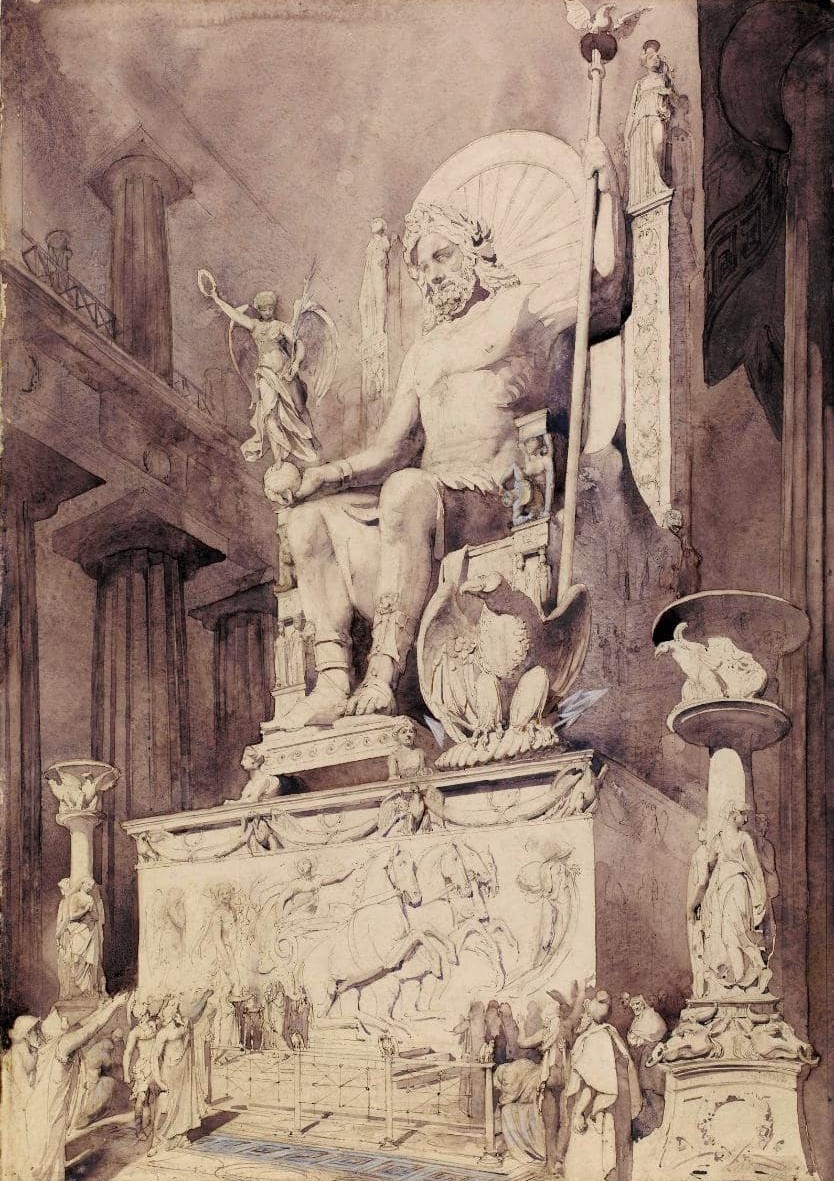
“We must bear in mind that before the time when the Olympian Jupiter was anthropomorphized by the genius of Pheidias into the Omnipotent God, the Maximus, the God of gods, and thus abandoned to the adoration of the multitudes, in the earliest and abstruse science of symbology he embodied in his person and attributes the whole of the cosmic forces. The Myth was less metaphysical and complicated, but more truly eloquent as an expression of natural philosophy. Zeus, the male element of the creation with Chthonia — Vesta (the earth), and Metis (the water) the first of the Oceanides (the feminine principles) — was viewed according to Porphyry and Proclus as the zoon-ek-zoon [zôion ek zôíou], the chief of living beings. In the Orphic theology, the oldest of all, metaphysically speaking, he represented both the potentia and actus, the unrevealed cause and the Demiurge, or the active creator as an emanation from the invisible potency. In the latter demiurgic capacity, in conjunction with his consorts, we find in him all the mightiest agents of cosmic evolution — chemical affinity, atmospheric electricity, attraction, and repulsion.” (Isis Unveiled, Vol. 2, pp. 261-62. Brackets added)
The dual nature receives extended treatment, and it is shown the manner in which the modern Theosophists and Hermeticists sought to provide their commentary on the classical sources. This dual nature is expressed by both Kingsford and Blavatsky.
“There are many orders of the gods; and in all there is an intelligent part. It is not to be supposed they do not come within the range of our senses; on the contrary, we perceive them, better even than those which are called visible. . .There are then gods, superior to all appearances; after them come the gods whose principle is spiritual; these gods being sensible, in conformity with their double origin, manifest all things by a sensible nature, each of them illuminating his works one by another.* The Supreme Being of Heaven, or of all that is comprehended under this name, is Zeus, for it is by Heaven that Zeus gives life to all things.” (Anna Kingsford & Edward Maitland, VIRGIN OF THE WORLD. 1884., pg. 65.)
Between the abstract deity and the Olympic Zeús lies an abyss. The latter represents the lower aspect of human physical intelligence, or mind wedded to the passional nature. When Zeús is depicted as yielding to lower passions he is symbolized as a serpent, bull, swan, eagle, raining gold and fire (the passionate cosmic creative principle), embodying the erotic, fertile, and chthonic energies. The allegory of Kronos cursing Zeús for dethroning him and for creating a weaker physical race is read as a philosophical statement about the origin of evil: the gift of mind, once mixed with matter, becomes the source of sorrow when spiritual evolution fails to keep pace with physical development.
PROMETHEUS, FATHER OF MANKIND AND MANKIND AS THE FALLEN PROMETHEUS
Zeús was traditionally hailed as “Father of gods and men” (πατὴρ ἀνδρῶν τε θεῶν τε in Homer), the supreme patriarch who embodies providence and authority. But in the Prometheus myth, this role is inverted: Prometheus becomes the “Father of Mankind,” because he is the one who truly nurtures humanity, giving them fire, arts, and survival skills. Hence, in contrast to Zeús in his form of chthonic energy, mankind is defined as Promethean, possessing the self-conscious fire that can take the heavens by violence. But the problem is that humanity daily re-enacts the drama of Prometheus the Titan chained by the lower passions of the “sensual Zeús .”
“A god . . . in fetters, anguish fraught;
The foe of Zeus, in hatred held by all. . . .”
“For that to men he bare too fond a mind. . .”
(Aeschylus, PROMETHEUS BOUND)
The modern human being has become Epimetheus, “he who sees only after the event”:
“because the universal philanthropy of the former has long ago degenerated into selfishness and self-adoration. Man will re-become the free Titan of old, but not before cyclic evolution has re-established the broken harmony between the two natures — the terrestrial and the divine; after which he becomes impermeable to the lower titanic forces, invulnerable in his personality, and immortal in his individuality, which cannot happen before every animal element is eliminated from his nature. When man understands that “Deus non fecit mortem” (Sap. I., 13), but that man has created it himself, he will re-become the Prometheus before his Fall.” (THE SECRET DOCTRINE, Vol. 2, pg. 422.)
This supports the idea that nature is ensouled, but it diverges in ways from the classical Greek philosophers’ language of emergence, infusion and evolution of nature as unfolding according to its own inherent necessity (anankē) and law (nomos).
“Zeus was the human soul and nothing more, whenever shown yielding to his lower passions, — the jealous God, revengeful and cruel in its egotism (…) Hence, Zeus is represented as a serpent — the intellectual tempter of man…” (THE SECRET DOCTRINE, Vol. 2, pg. 419-20.)
Humankind possesses the self-conscious fire, suggesting that a demi-god must sometimes battle a mad tyrant, or the passional Zeús (the lower mind aspect).
“Initiates of the Greek Mystery schools were familiar with the idea, having themselves undergone arduous moral, psychological, and mental training and purification in preparation for the sacred experience of transcendent Reality. In similar fashion, the Pythias, by subjugating a portion of their nature, were able to receive and pass on to others something of this import and wonder.” (Eloise Hart, The Delphic Oracle)
Blavatsky is explicit that the true theosophist refuses to identify the unknown absolute deity with either Zeús or Yahweh, but many theosophists still slipped into anthropomorphism, specifically when insisting that evolution is guided by cosmic intelligence — a kind of directing universal mind or Demiurge. Any degree of anthropomorphism that typically accompanies common views about Zeus in the ancient world are different from the actual historical ancient cults of Zeús and Stoics who depicted Zeus as the immanent aspect, or fertile hidden unity of life permeating the cosmos. The Zeus of the Stoics corresponds the most however to the modern theosophical emphasis.
“The “Supreme Deity” bears, in every ancient Pantheon — including that of the Jews — a dual character, composed of light and shadow. Instead of “an untainted mind, heaven’s first gift” (AEschylus), there was created the eternal vulture of the ever unsatisfied desire, of regret and despair coupled with “the dreamlike feebleness that fetters the blind race of mortals” (p. 556), unto the day when Prometheus is released by his heaven-appointed deliverer, Herakles.
Now Christians — Roman Catholics especially — have tried to prophetically connect this drama with the coming of Christ. No greater mistake could be made. The true theosophist, the pursuer of divine wisdom and worshipper of absolute perfection — the unknown deity which is neither Zeus nor Jehovah — will demur to such an idea. Pointing to antiquity he will prove that there never was an original sin, but only an abuse of physical intelligence — the psychic being guided by the animal, and both putting out the light of the spiritual.” (THE SECRET DOCTRINE, Vol. 2., pg. 413.)
Here, she states there never was an original sin, only an abuse of physical intelligence in which the psychic, guided by the animal, extinguished the light of the spiritual (The Secret Doctrine, Vol. 2, p. 413).
“(…) no nation has ever conceived the One principle as the immediate creator of the visible Universe, for no sane man would credit a planner and architect with having built the edifice he admires with his own hands. On the testimony of Damascius ([[Peri archon]]) they referred to it as “the Unknown Darkness.” The Babylonians passed over this principle in silence: “To that god,” says Porphyry, in [[Peri apoches empsuchon]], “who is above all things, neither external speech ought to be addressed, nor yet that which is inward. . . . .” Hesiod begins his theogony with: “Chaos of all things was the first produced,”† thus allowing the inference that its cause or producer must be passed over in reverential silence. Homer in his poems ascends no higher than Night, whom he represents Zeus as reverencing. According to all the ancient theologists, and to the doctrines of Pythagoras and Plato, Zeus, or the immediate artificer of the universe, is not the highest god; any more than Sir Christopher Wren in his physical, human aspect is the Mind in him which produced his great works of art.” (THE SECRET DOCTRINE, 1888, Vol. 1, pg. 425-26.)
Helena P. Blavatsky states the central thesis directly:
“Therefore, all the creative gods, or personal Deities, begin at the secondary stage of Cosmic evolution. Zeus is born in, and out of Kronos—Time.” (The Secret Doctrine, Vol. 1, p. 427)
PROMETHEUS AND THE REPUBLICAN REFUSAL OF ABSOLUTE AUTHORITY
The Christian reframing of Prometheus as a figure of evil (or as a pagan analogue of Lucifer) is anti-democratic and anti-republican because it converts a culture-hero who empowers humanity into a cautionary emblem of sinful rebellion against hierarchical authority. In the classical sources Prometheus is the civilizer who steals fire, representing knowledge, technique, and the means of organized social life, and thereby raises mankind from mere survival toward self-conscious agency. His conflict with Zeús is the mythic prototype of resistance to arbitrary power. When patristic and later Christian interpreters recast that same act as prideful disobedience, the gift of fire becomes the forbidden fruit of original sin, and the Titan’s defiance is assimilated to Satan’s fall. The political consequence is immediate. Human aspiration, civic innovation, and the questioning of sovereign will are pathologized as diabolical rather than celebrated as the foundation of free citizenship. Republican liberty (non-domination) and democratic self-rule both presuppose that citizens may legitimately challenge concentrated power and expand the sphere of shared knowledge; and a theology that brands such activity as Luciferian necessarily sacralizes obedience, underwrites divine-right hierarchy, and treats popular agency itself as a standing threat to cosmic order. The equation is therefore not a neutral allegorical reading but a deliberate inversion that strips the Promethean motif of its emancipatory content and places it in the service of anti-republican authority.
SUPPRESSED HELLENISTIC JEWISH INFLUENCE ON CHRISTIAN REPUBLICAN THINKERS
The Greek-style distinction between an absolute, ineffable First Principle and a secondary, active Creator (or demiurgic power) appears in Hellenistic Jewish thought, most clearly in Philo of Alexandria’s LOGOS as the intermediary principle, and later in Kabbalistic formulations such as Ein Sof versus the sefirot. This conceptual space made it easier to treat even divine authority as ordered and limited rather than as an unlimited personal will that could be mirrored by absolute earthly kings. Combined with the Hebrew Bible’s own anti-monarchical texts (especially 1 Samuel 8 and the Mosaic constitution), it helped inscribe early ideas of government under law, mixed or popular elements, and resistance to sacralized tyranny.
These strands fed into the early modern “Hebraic republicanism” recovered by Christian Hebraists in the sixteenth and seventeenth centuries from the “Hebrew Republic” (Respublica Hebraeorum) ideal. That tradition argued that a non-monarchical republic was the only legitimate regime, influenced Dutch and English republican thought, and left traces in later Christian political theory. Yet both within Judaism, after the loss of political sovereignty, and within mainstream Christianity (where divine-right monarchy and hierarchical theocracy became dominant), the more explicitly republican and anti-absolutist readings were marginalized or suppressed. They survived as minority or revival currents rather than as the prevailing orthodoxy.
CONCLUSION
The classical tradition presents Zeús as the effective lord of the visible order, the demiurgic intelligence that shapes and sustains the cosmos, and the all-pervading Aether of Orphic hymn. It also places him within a genealogy that begins in Kháos and Nýx and distinguishes him from any ungenerated First Principle. The tensions between cosmic principle and passionate Olympian, between demiurge and jealous tyrant, between the benefactor of order and the punisher of Promētheús, are internal to the sources themselves. The Theosophical interpretation systematized those tensions into a coherent cosmology of secondary creators, dual human nature, and progressive spiritual evolution. The concept of the dual don Juan Zeús is inherited from Homer, Hesiod, the Orphic theologians, and the Neoplatonists, and reads him as one more instance of the universal pattern in which the immediate artificer is never identical with the UNKNOWN DARKNESS that precedes all manifestation.
The Greek dual view of Zeús is more honest in its open preservation of unresolved tensions, and structurally closer to certain strands of the Jewish tradition than to mainstream Christian orthodoxy. They did not force the tensions into a single, seamless portrait. Mainstream Christianity, by contrast, more insistently collapses the Creator into the absolute: God is both the personal, willing agent of Genesis and the ungenerated, perfect First Principle, with dualism (or a secondary demiurge) rejected as heresy. Negative theology exists, but the dominant tendency is resolution rather than sustained paradox. Jewish thought, especially in its mystical and philosophical schools’ tradition of reverential silence about the ultimate, more readily distinguishes the active, personal Creator from a higher, ineffable absolute. The biblical God remains personal and covenantal, yet the structural pressure to place something prior to creative activity is acknowledged rather than erased. In that limited but real sense, the Greek dualism of Zeus is closer to the Jewish handling of the problem than to the Christian insistence on identity.
What must be further learned from what this teaches about the Christian depiction of Promētheús as evil, or as a pagan prefiguration of Lucifer, is that such a depiction is not a harmless theological preference but a political inversion that stands in direct opposition to the classical republican and democratic tradition. Where the Greek sources present the Titan as the culture-hero who confers fire, arts, and self-conscious agency upon mankind against the arbitrary will of Zeús, the Christian reframing converts that same gift into the original sin of prideful rebellion. Knowledge, technique, and the aspiration to rise above mere survival are thereby pathologized as diabolical rather than celebrated as the foundation of civic life.
Republican liberty, understood as non-domination, and Athenian democracy, which institutionalized the contestation of tyranny, both require that citizens may legitimately challenge concentrated power and expand the common store of knowledge. A theology that brands such activity Luciferian necessarily sacralizes obedience, supports hierarchical and monarchical claims, and treats popular agency itself as a standing threat to order. The classical insistence that Zeús is never the ungenerated First Principle, that the demiurge remains secondary to the UNKNOWN DARKNESS, and that Promētheús remains the true father of human culture, thus supplies the mythic grammar of republican resistance: no power, divine or human, may claim absolute sovereignty without becoming the very tyranny the free citizen is bound to oppose. To recover the Promethean motif in its original sense is therefore not to indulge pagan nostalgia but reaffirms the political-philosophical insight that supports and secures every genuine republic — the insight that civilization advances only when the sacred FIRE of knowledge is shared and when arbitrary authority, however exalted its title, is refused.
REFERENCE SOURCES
- Aeschylus. Prometheus Bound. Translated by Herbert Weir Smyth. Cambridge, MA: Harvard University Press, 1922.
- Damascius. On First Principles. Translated by Sara Ahbel-Rappe. Oxford: Oxford University Press, 2010.
- Eric Nelson. The Hebrew Republic: Jewish Sources and the Transformation of European Political Thought. Cambridge, MA: Harvard University Press, 2010.
- Helena P. Blavatsky. Isis Unveiled. 2 Vols. New York: J. W. Bouton, 1877 (1972 ed. referenced).
- Helena P. Blavatsky. The Key to Theosophy. London: Theosophical Publishing Company, 1889.
- Helena P. Blavatsky. The Secret Doctrine. 2 Vols. London: Theosophical Publishing Company, 1888.
- Hesiod. Theogony. Translated by Hugh G. Evelyn-White. Cambridge, MA: Harvard University Press, 1914.
- Homer. Iliad. Translated by A. T. Murray. Cambridge, MA: Harvard University Press, 1924.
- Philo of Alexandria. On the Special Laws and related treatises (discussions of Mosaic polity and democracy). See Lévy, Carlos. “Philo of Alexandria.” Stanford Encyclopedia of Philosophy, 2018.
- Porphyry. On Cult Statues (fragments preserved in Eusebius, Praeparatio Evangelica).
- Proclus. The Theology of Plato. Translated by Thomas Taylor. London, 1816.
- Thomas Taylor, trans. The Mystical Initiations; or, Hymns of Orpheus. London, 1792.
- W.S.W. Anson. Asgard and the Gods: Tales and Traditions of our Northern Ancestors. London: W. Swan Sonnenschein, 1880.
FOOTNOTES
- The use of the Greek accents instead of the modern English root them in their linguistic tradition and is not for aesthetics. Greek gods and primordial beings are Greek. Their names carry the sound and rhythm of the language they come from; and the same letters convey different concepts. Kháos, e.g., with its proper accent differentiates from both the mere Khaos without it and Chaos in modern English meaning “disorder.” Whereas Kháos (Χάος) referring to a vast gaping chasm is one of those Greek concepts that looks simple in English but becomes far more profound once you restore the Greek language, accents, and worldview behind it. When Hesiod writes Χάος, he is not describing “disorder” or “confusion.” He is describing the first condition of existence, a metaphysical state that is neither matter nor void, neither deity nor place. It is seen as it is the stage of first separation, or the moment where “inside” and “outside” becomes possible. ↩︎
- When Orpheus terms the power of Zeus, Æther, “the high-reigning, ever indestructible power of Zeus” in the fifth hymn to Zeus discussed earlier, Blavatsky addressed this in her glossary in The Key to Theosophy, explaining that “Aether” (Aithḗr) is defined as “the Divine luminiferous substance which pervades the whole universe; the ‘garment’ of the Supreme Deity, Zeus, or Jupiter” (The Key to Theosophy, Glossary). ↩︎
APPENDIX
We hear first the voice of Homer, singer of the wrath of Achilles and the returns of heroes in Iliad 2.350 and Iliad 2.670. Thus the poet sets the king upon his throne, yet never without the name of the father who came before him. Turn next to Hesiod, who sings the birth of the gods themselves. “Verily at the first Chaos came to be, but next wide-bosomed Earth, the ever-sure foundation of all the deathless ones who hold the peaks of snowy Olympus, and dim Tartarus in the depth of the wide-pathed Earth, and Eros, fairest among the deathless gods” (Theogony 116-120). From this first gaping void arise Gaia and Ouranos; from them Kronos; from Kronos and Rhea, Zeus. The succession is written in the blood of fathers overthrown by sons. Zeus swallows Metis so that no child of his shall cast him down in turn (Theogony 886-900). ORDER is purchased by the containment of the next revolution. Now the Orphic singers raise a different strain. Zeus, they sing, “is the root of the sea, Zeus is the sun and the moon; Zeus is the king, Zeus the ruler of all, the god of the bright lightning” (Orphic Fragment 168 Kern, preserved by Porphyry in On Cult Statues). Here the king becomes the cosmos itself. He is no longer merely the strongest of the Olympians. He is now the living whole that contains every part. Porphyry, commenting on the same tradition, declares that those who wrote the works of Orpheus “supposed Zeus to be the intellect of the cosmos, who contains the cosmos and has created the things within it” (Porphyry, On Cult Statues). Yet even this exalted vision, Damascius recorded that the ancient theologians passed over the highest principle in reverential quiet, calling it “the Unknown Darkness” (Damascius, On First Principles 123). The artificer is never the absolute origin. Aeschylus stages the cost of this arrangement. Prometheus, chained to the rock by the will of Zeus, cries out against the new tyrant who has ordered the world at the price of the older freedoms (Prometheus Bound 1-87). The fire that raises humanity is punished by the same power that benefits from the ordered cosmos. The dual face of Zeus as benefactor and despot, all-pervading Aether and jealous king stands revealed. Thus the sources speak, one after another, in their own tongues: Homer’s lord of men who remains a son; Hesiod’s ordered successor who still fears the next usurper; the Orphic all-containing intellect who is nevertheless secondary to the Unknown Darkness; the tragic Zeus of Aeschylus who binds the Titan that gave fire to mankind. The tensions are not resolved. They are simply held, generation after generation, in the poetry and philosophy of the Greeks. This is one of the oldest and most persistent theological problems in monotheistic and quasi-monotheistic systems: the status of the First Principle relative to the Creator (or creative principles).